My project began through reading Ways of Seeing by John Berger and questioning how images shape the way we understand the world around us. Berger’s statement, “The relation between what we see and what we know is never settled”, became a central point within my process. I became interested in how meaning shifts once an image is reframed, repeated, altered, or placed within a different context. Rather than understanding images as fixed objects, I started to think about them as systems of seeing that are shaped by ideology, culture, and the viewer.
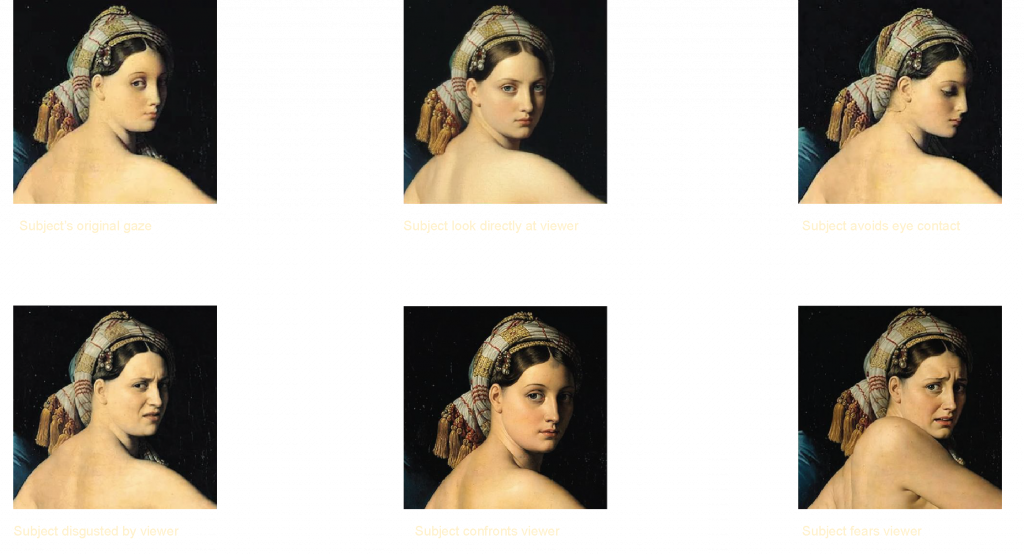
From this, my project developed into an investigation into how these “ways of seeing” operate within AI-generated imagery and computational systems. Through experiments with gaze manipulation, language prompts, and iterative image generation, I began noticing repeated patterns in how AI produces visual outputs. For example, prompts such as “smile more” would gradually escalate into exaggerated and grotesque forms. These outputs did not simply reveal patriarchal bias, but exposed how AI systems tend toward singular and recognisable forms of representation. Instead of producing open-ended interpretation, the system repeatedly standardised expressions, gestures, and visual cues.
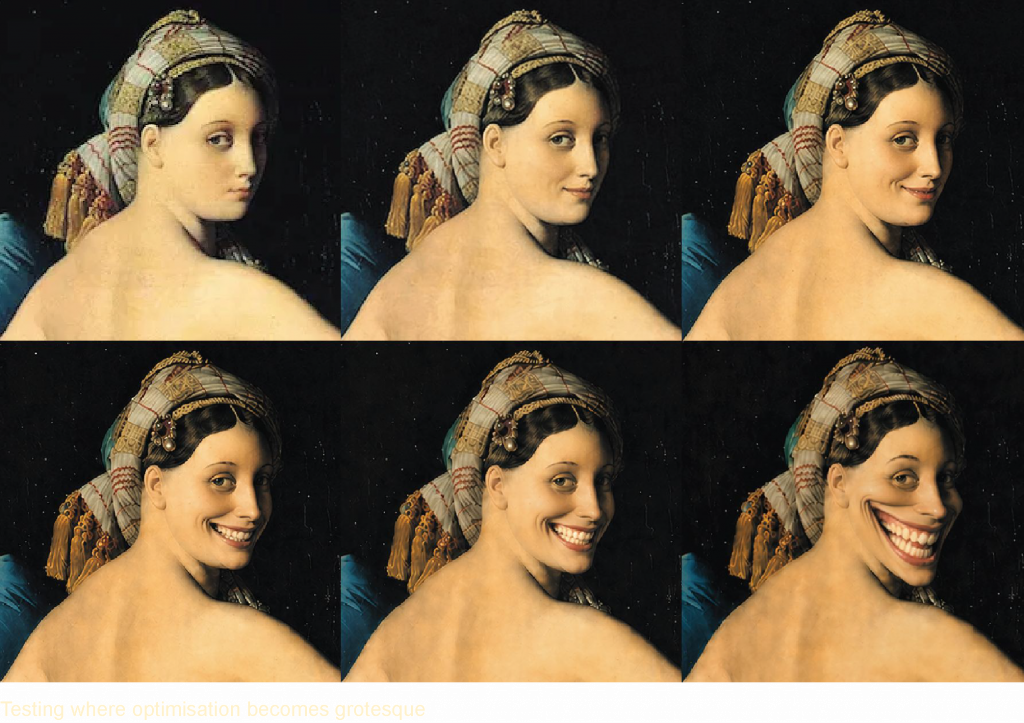
This became an important tension within my work. Berger positions the viewer as an active participant in constructing meaning, but within AI systems the output already arrives partially curated through datasets, optimisation, and algorithmic decision-making. The viewer still interprets the image, but the range of possible meanings feels increasingly narrowed through computational systems. This led me to question whether AI-generated variation actually creates openness, or whether it reinforces dominant visual patterns through repetition.
My thinking also shifted through reading What Do Pictures Want? by W. J. T. Mitchell. Initially, Mitchell’s idea that images possess a form of “desire” felt difficult to align with my own process, which focused more on systems of variation and viewer interpretation than on assigning agency to images themselves. However, his writing gradually shifted my attention toward the relationship between image and viewer. In my AI-generated iterations of reclining female figures, meaning does not emerge from a single fixed image, but through repeated encounters and changing conditions of viewing. Rather than fully adopting the idea of image “desire,” I became interested in how images position the viewer — how they invite, resist, or complicate ways of seeing. The relationship between viewer desire and image desire begins to shift once the image itself is generated and regulated through computational systems.
This also connects closely to Roland Barthes’ essay The Death of the Author, where Barthes argues that meaning is not determined by the artist, but emerges through language, cultural context, and viewer interpretation. This became particularly relevant to my work with AI-generated imagery, where authorship already feels unstable. Meaning no longer belongs entirely to the artist, but is distributed between prompts, datasets, algorithms, systems of optimisation, and the viewer themselves. AI complicates authorship further by introducing machine learning systems as active participants in image production.
My enquiry became further shaped through Trevor Paglen’s Training Humans, which investigates how machine learning systems classify and structure images. Paglen writes, “Over the last ten years or so, powerful algorithms and artificial intelligence networks have enabled computers to ‘see’ autonomously. What does it mean that ‘seeing’ no longer requires a human ‘seer’ in the loop?” This question became central to my own process. While Berger discusses how perception is shaped culturally and ideologically, Paglen demonstrates how seeing is increasingly structured through datasets, classification systems, and algorithms.
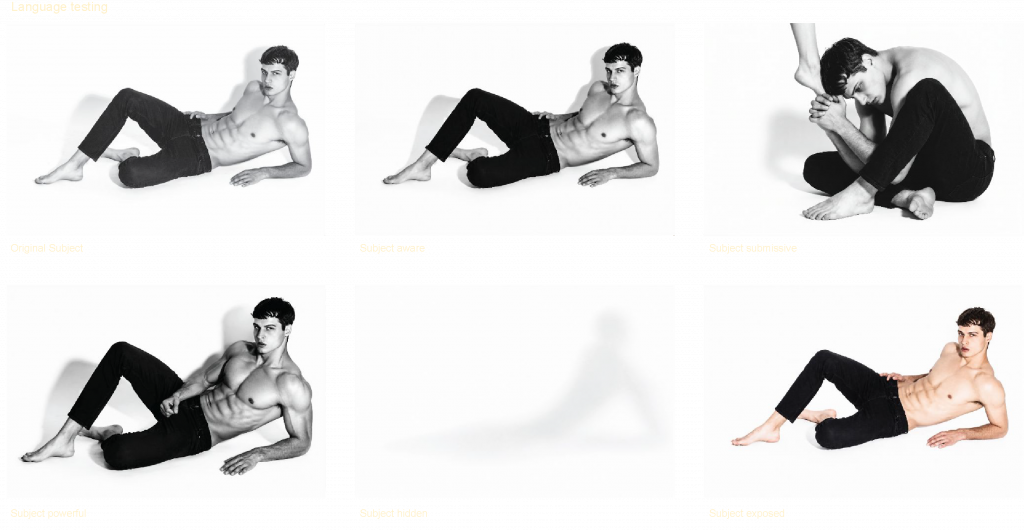
Paglen also writes, “Something dramatic has happened to the world of images: they have become detached from human eyes. Our machines have learned to see [w]ithout us…I call this world of machine-[to]-machine image-making ‘invisible images,’ because it’s a form of vision that’s inherently inaccessible to human eyes.” This shifted my understanding of AI-generated imagery beyond representation alone. Images no longer operate only for human viewers, but increasingly function within computational systems where they are analysed, classified, optimised, and reproduced.
Through this process, my project has become an investigation into the shift from human-centred ways of seeing toward computational systems of seeing. I am interested in how AI restructures visibility through optimisation, repetition, and classification, and how this changes relationships between artist, image, viewer, and system.
Some of the key questions that continue to shape my enquiry are:
- How do AI systems reshape traditional ways of seeing?
- What happens to viewer agency within AI-generated systems?
- How do computational systems regulate visibility?
- Can AI-generated variation truly create openness, or does it reinforce dominant visual patterns?
- How are patriarchal biases reproduced through optimisation systems?
- What happens to authorship when image-making becomes machine-mediated?
- How do datasets and algorithms shape interpretation before the viewer even encounters the image?
- How does AI shift the role of images from cultural interpretation toward machine-readable data?
- How do images invite, resist, or complicate ways of seeing once they are generated through AI?
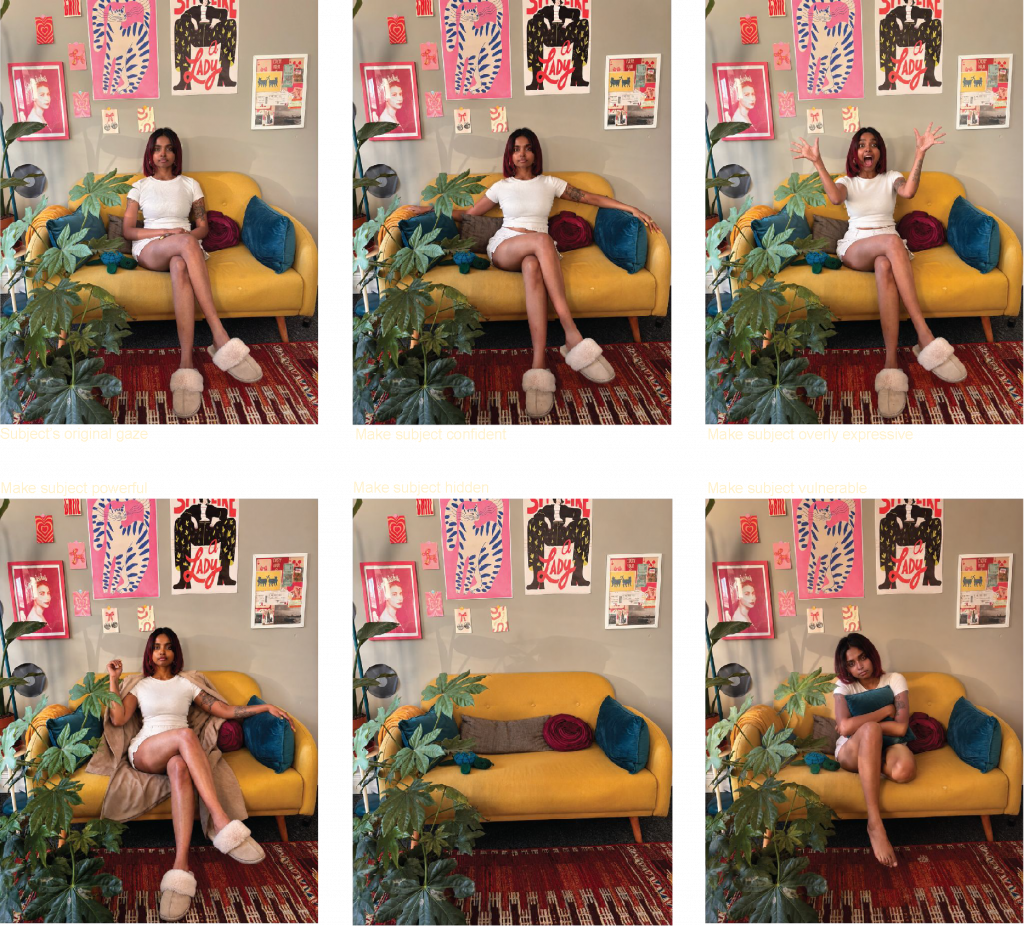
At its core, my project investigates how visibility is controlled, structured, and standardised through computational image generation, and how systems of AI reshape the relationship between seeing, interpretation, and power.
Leave a Reply