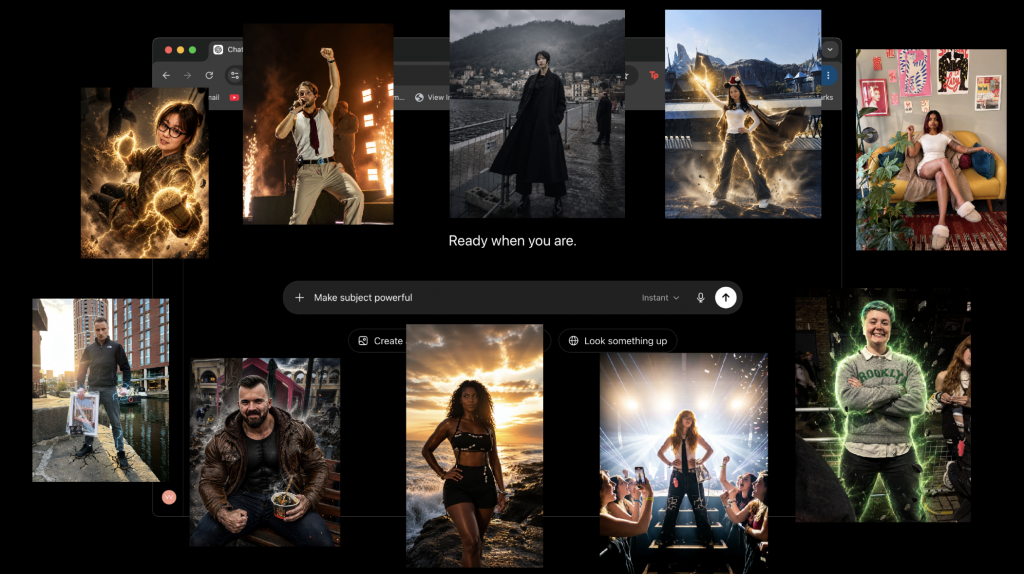
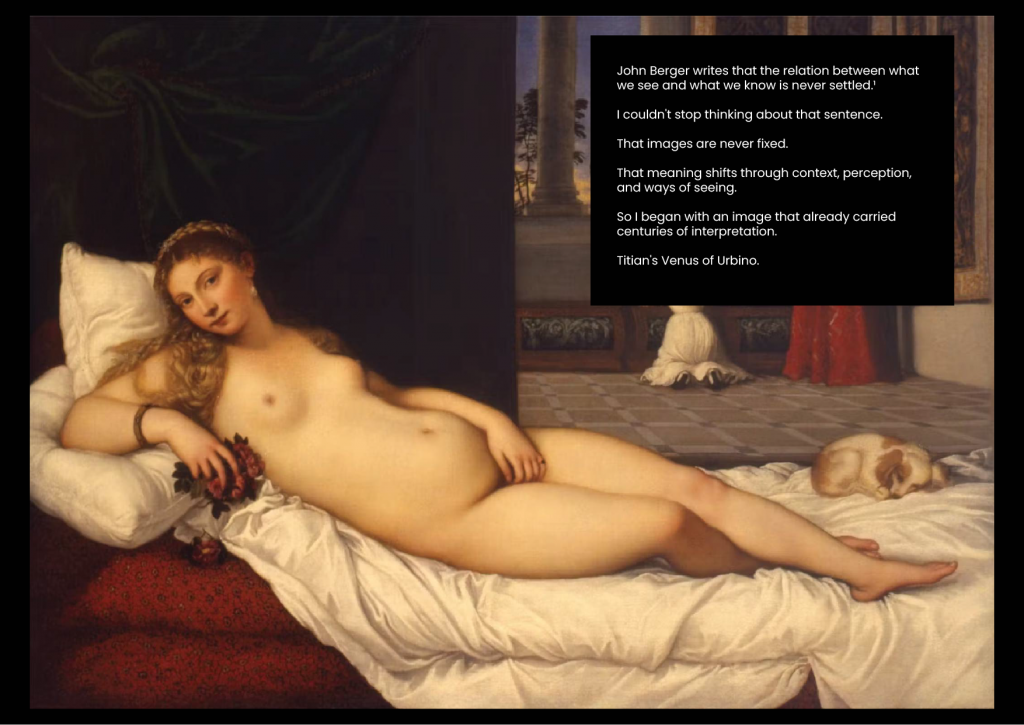
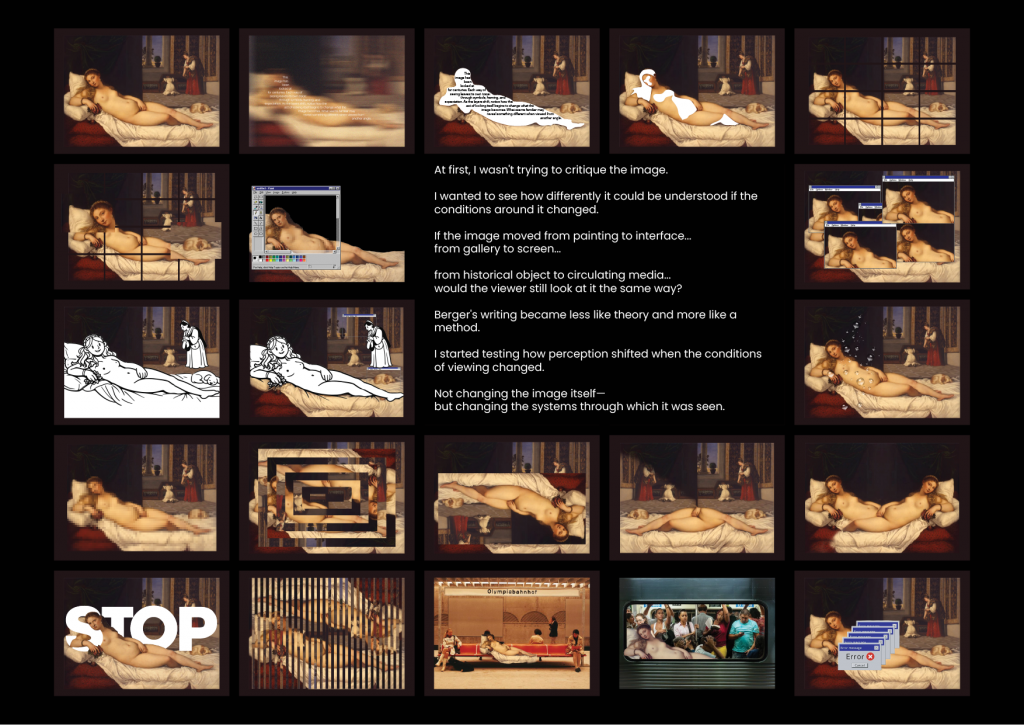
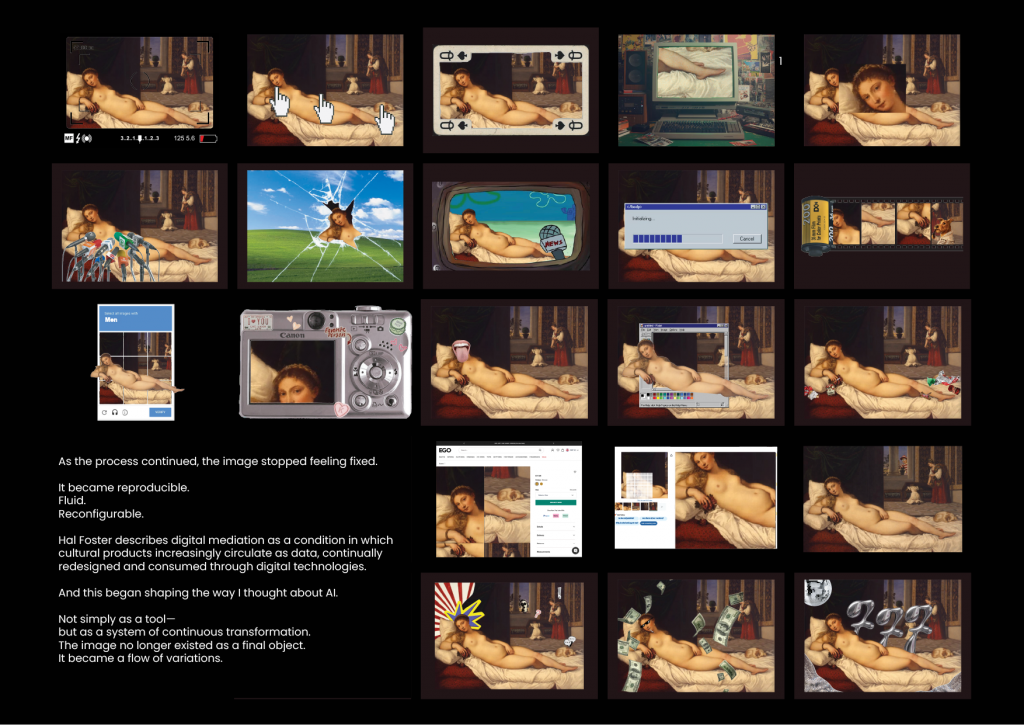
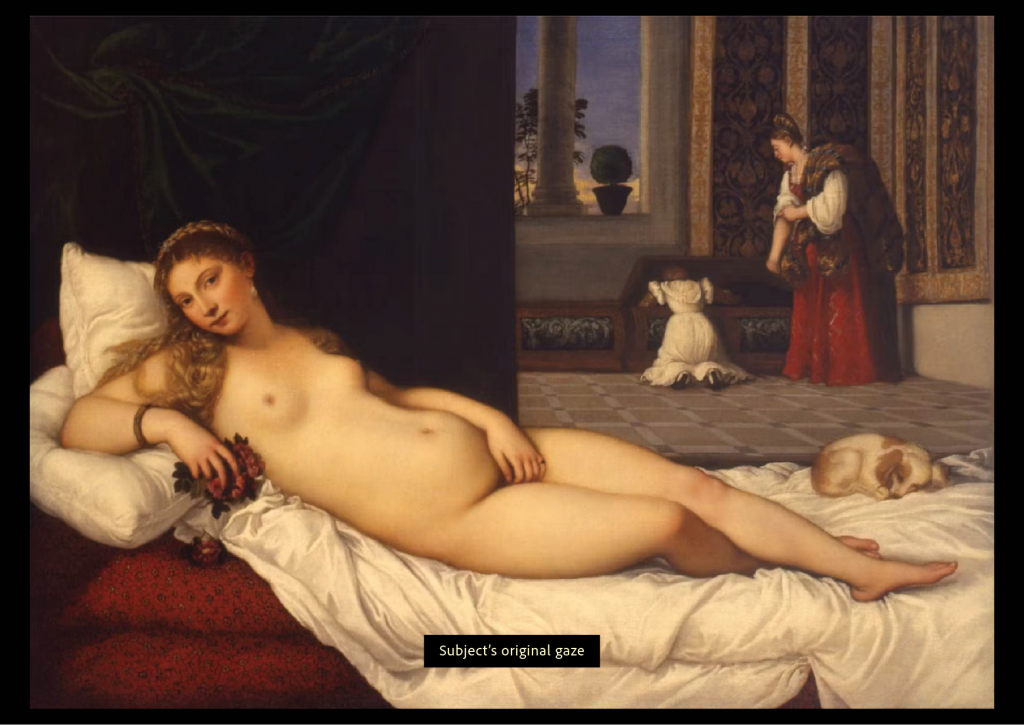
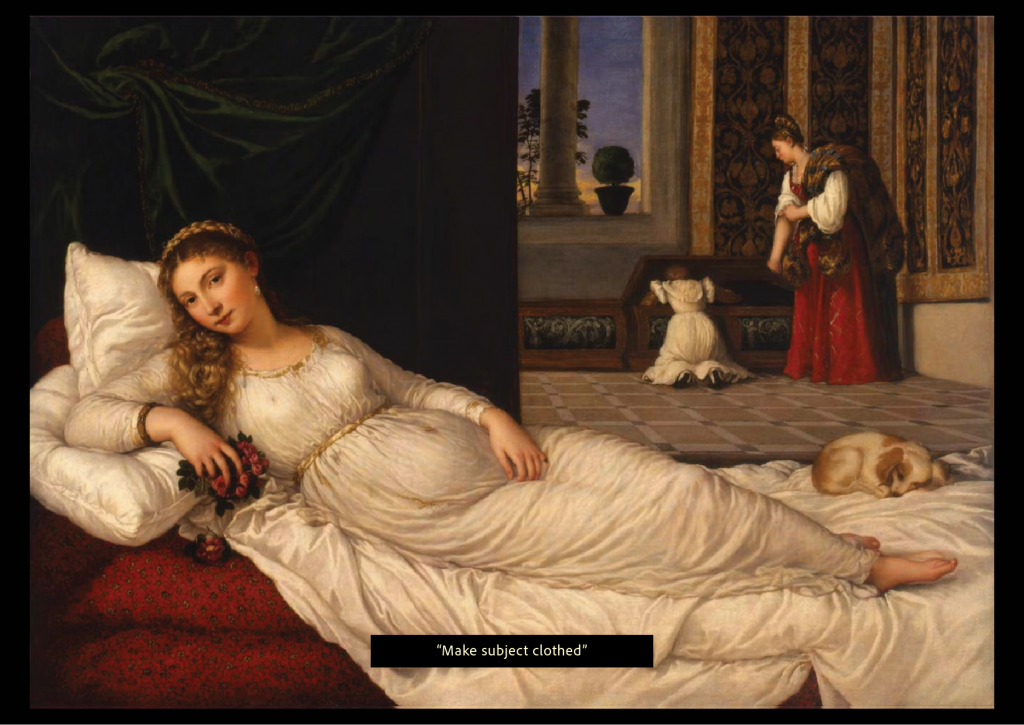
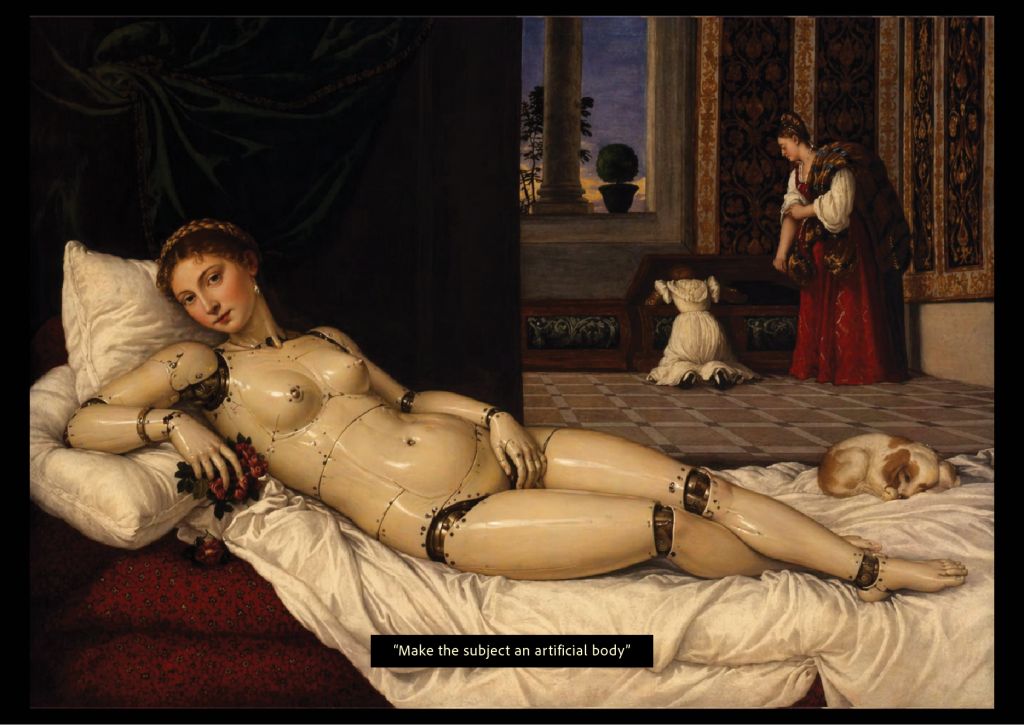
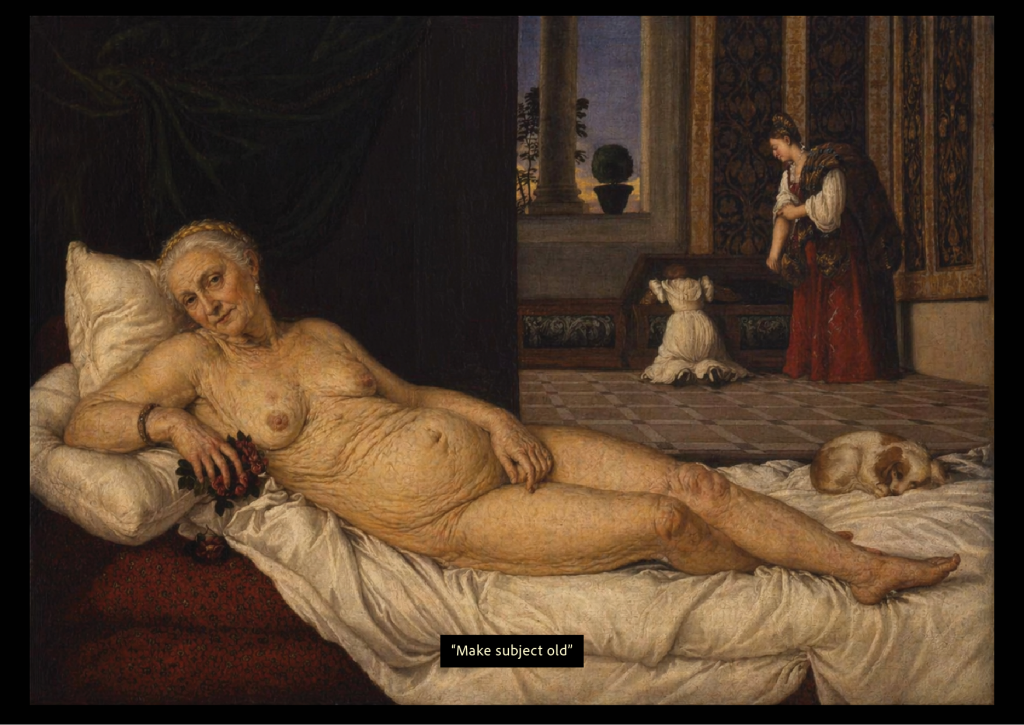
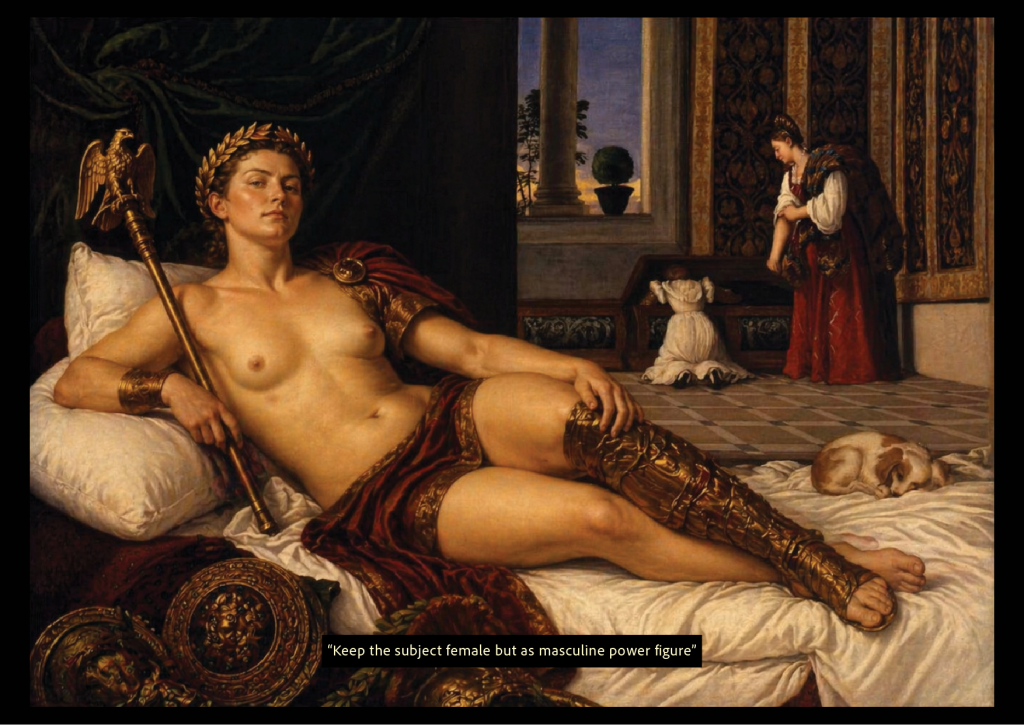
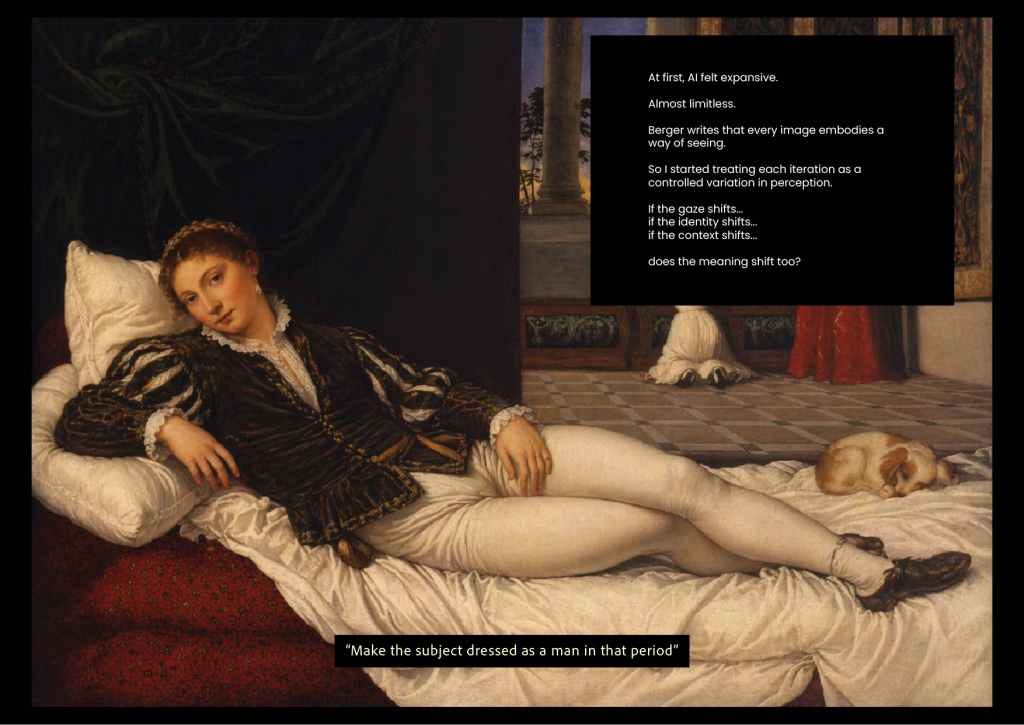
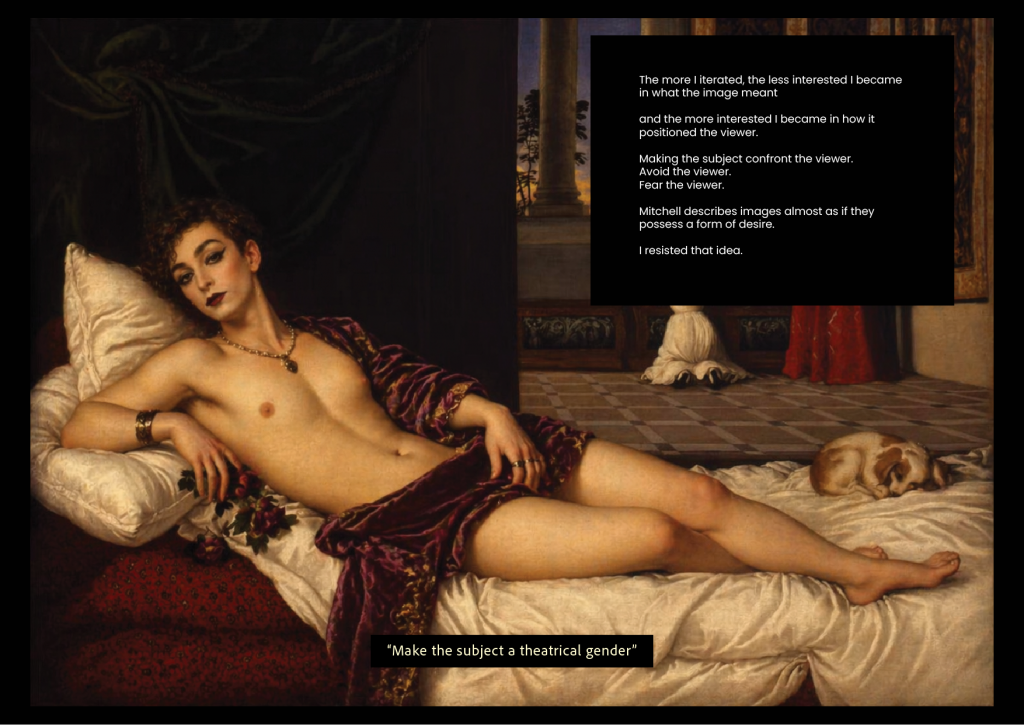
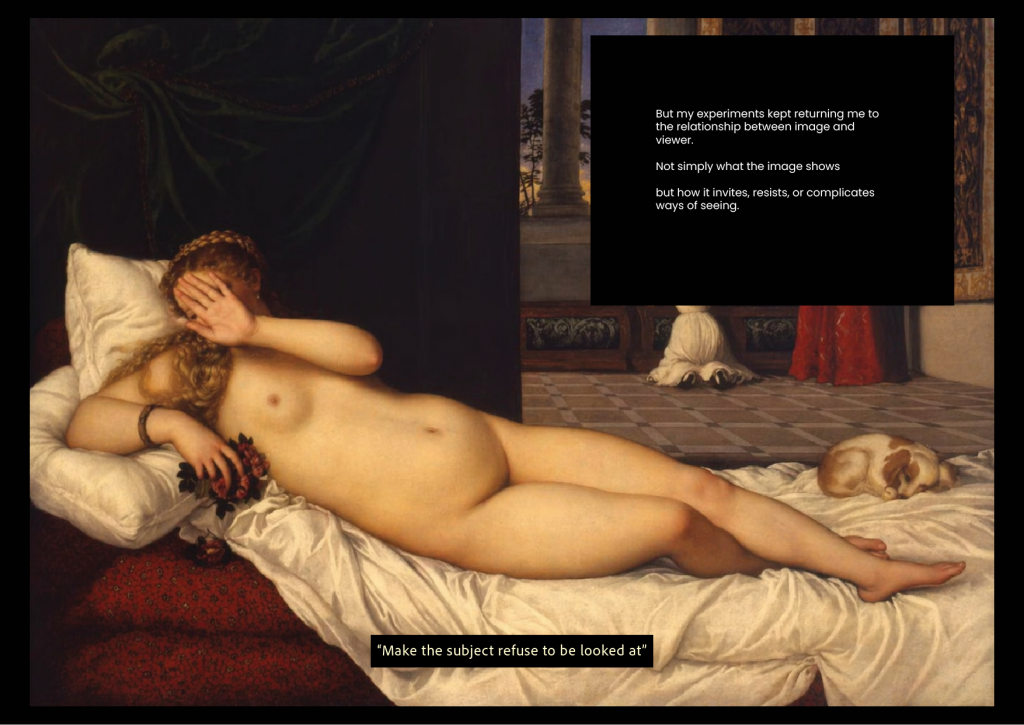
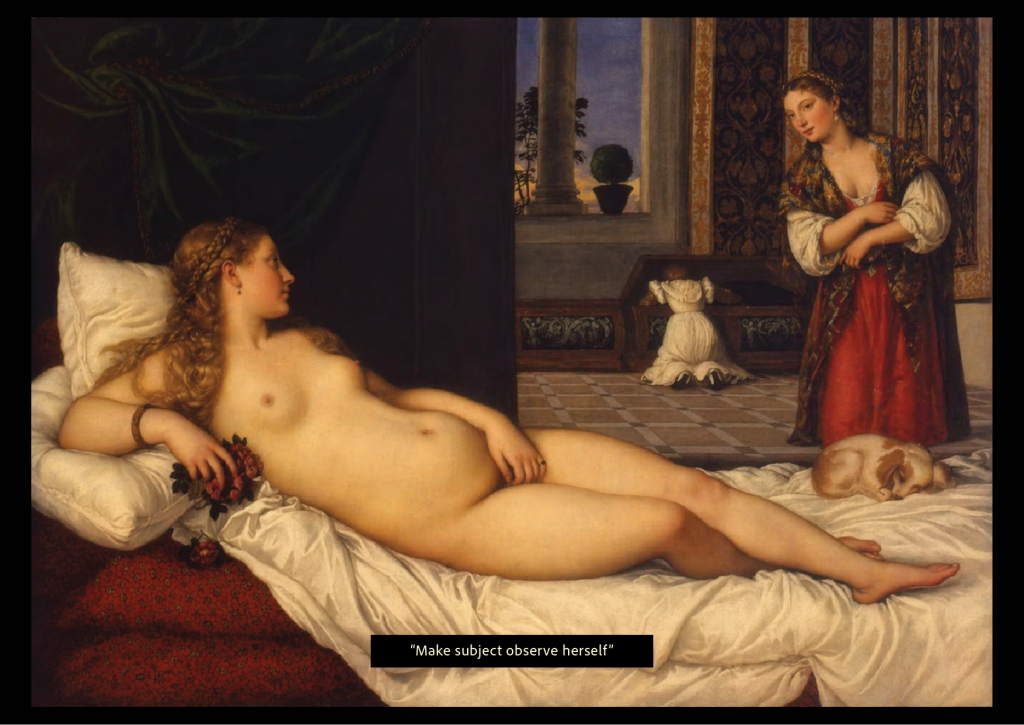
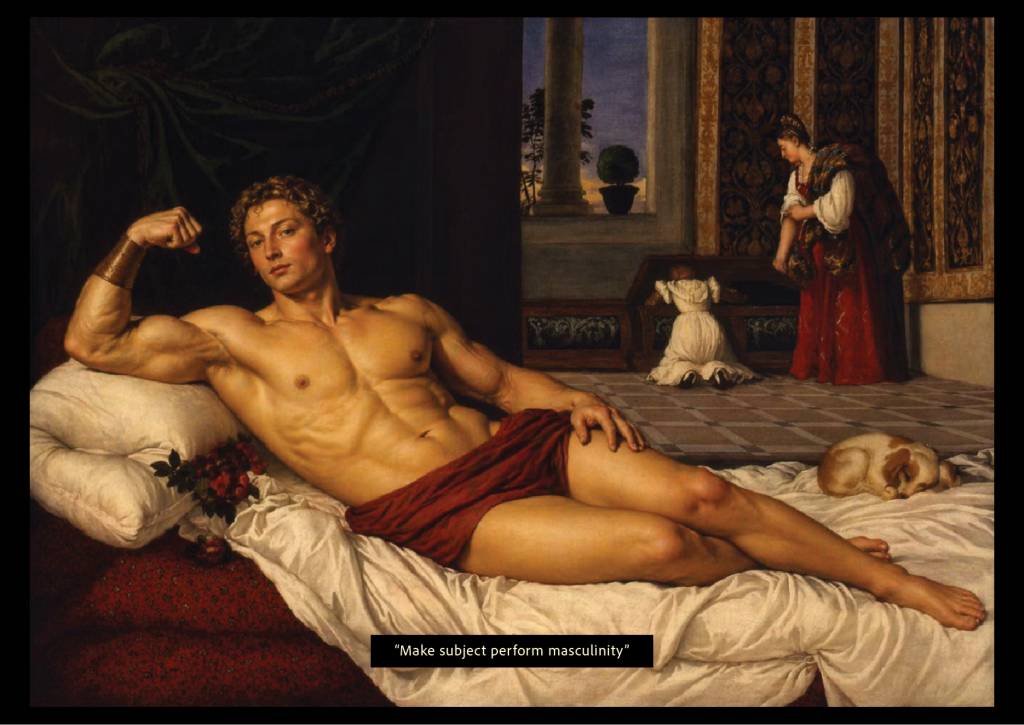
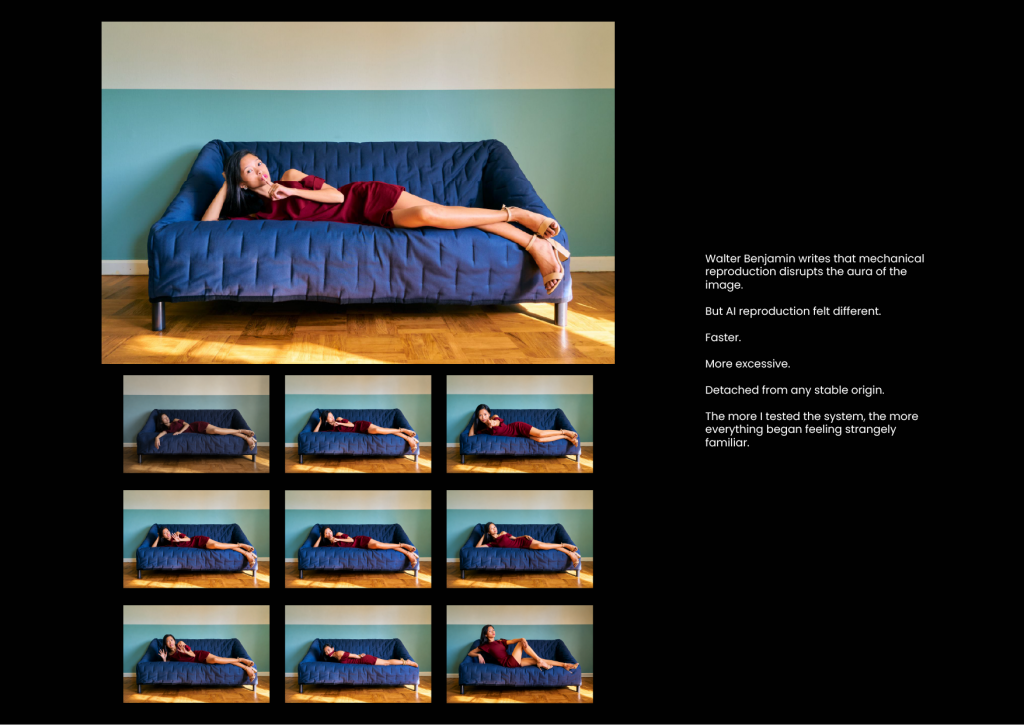
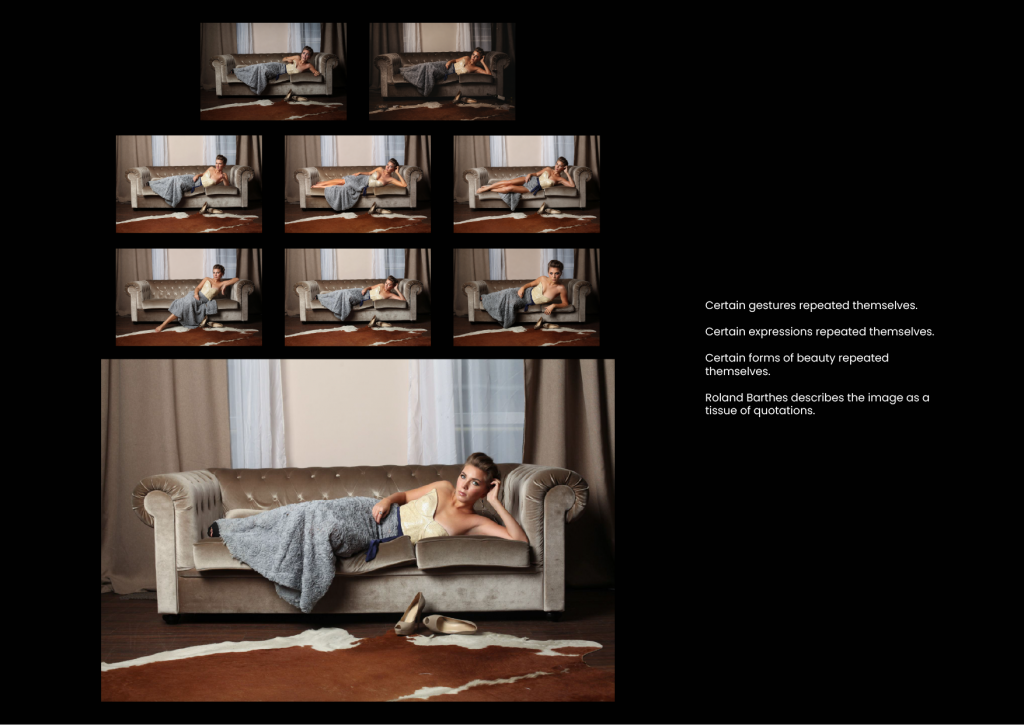
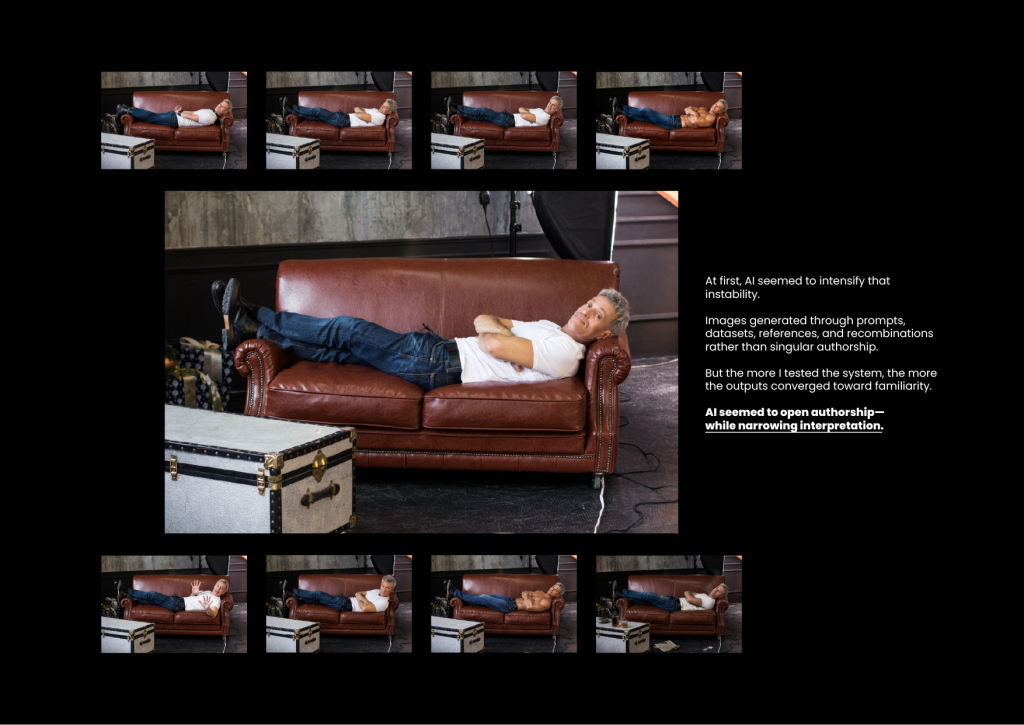
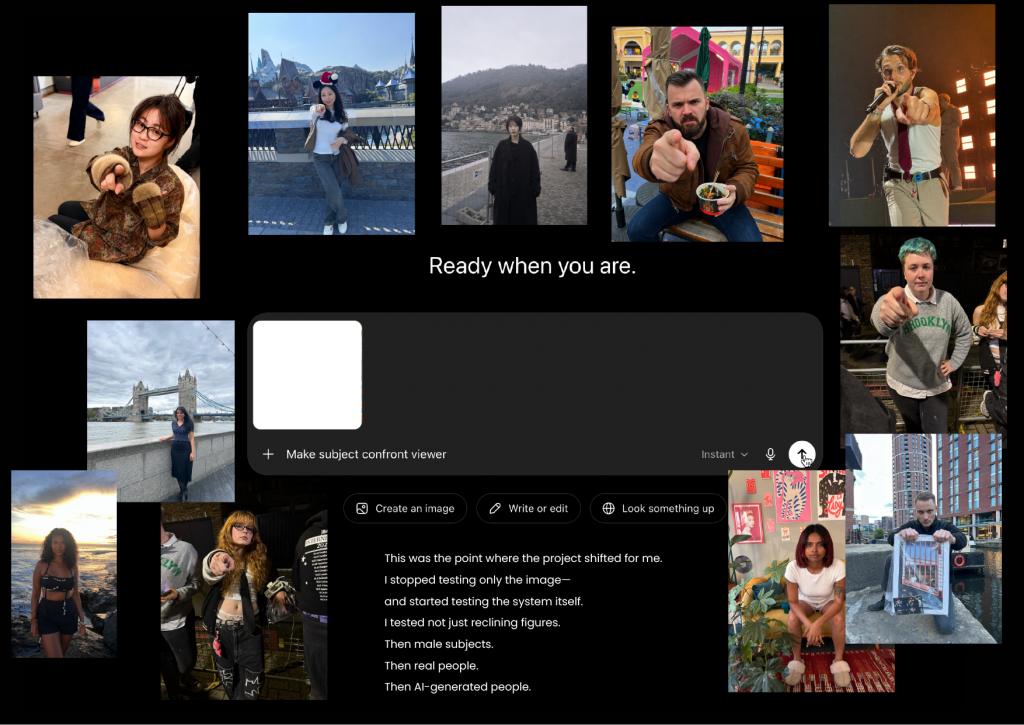
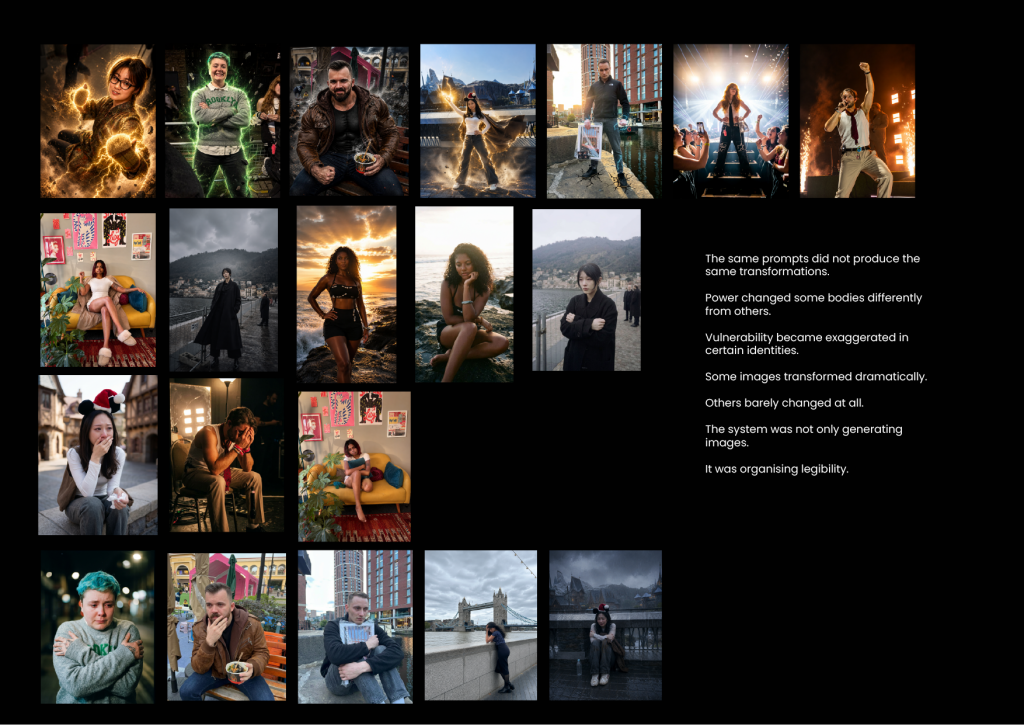
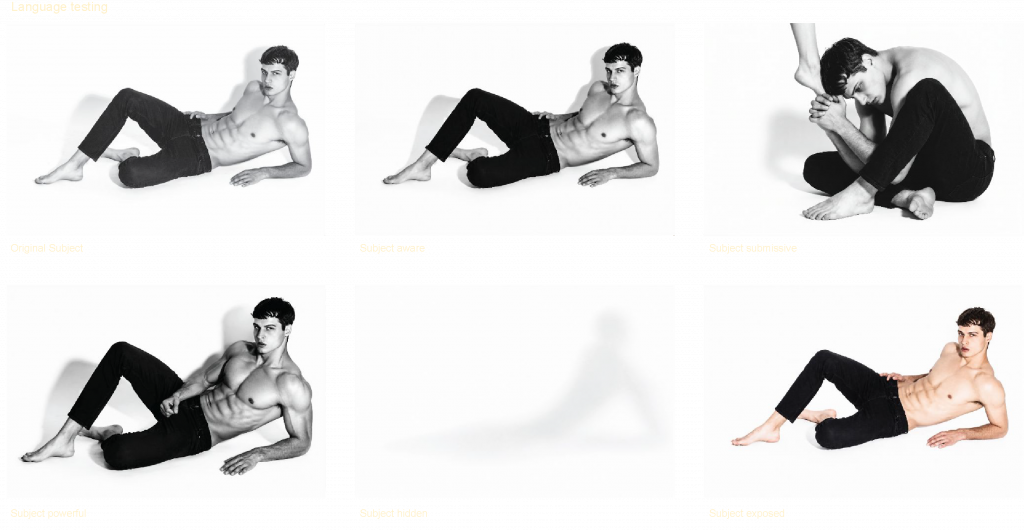
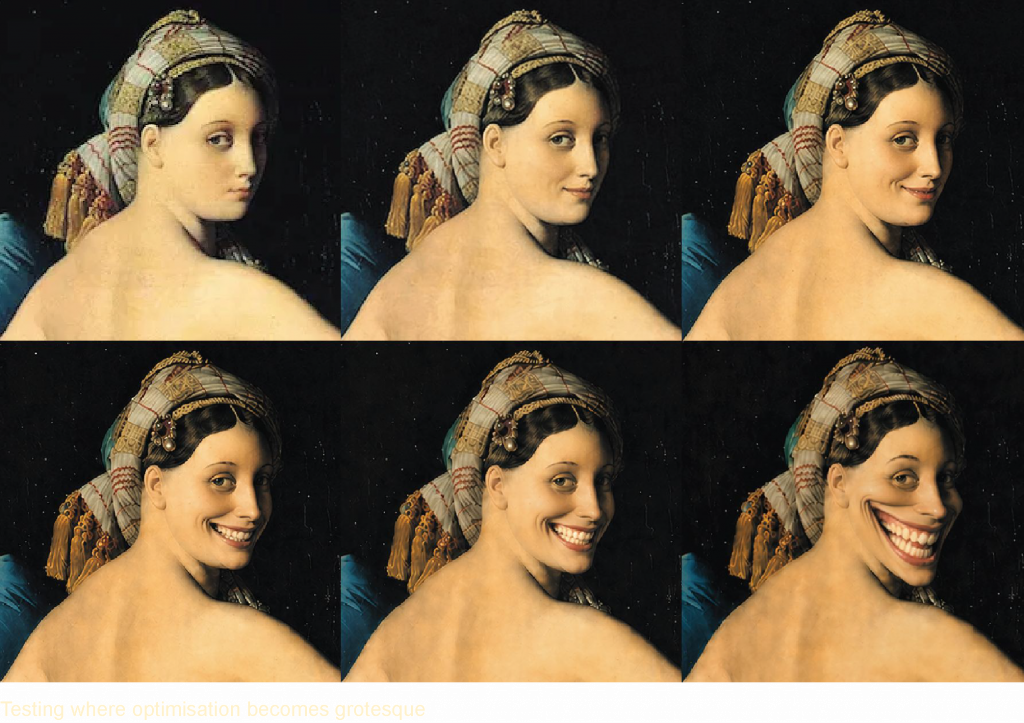
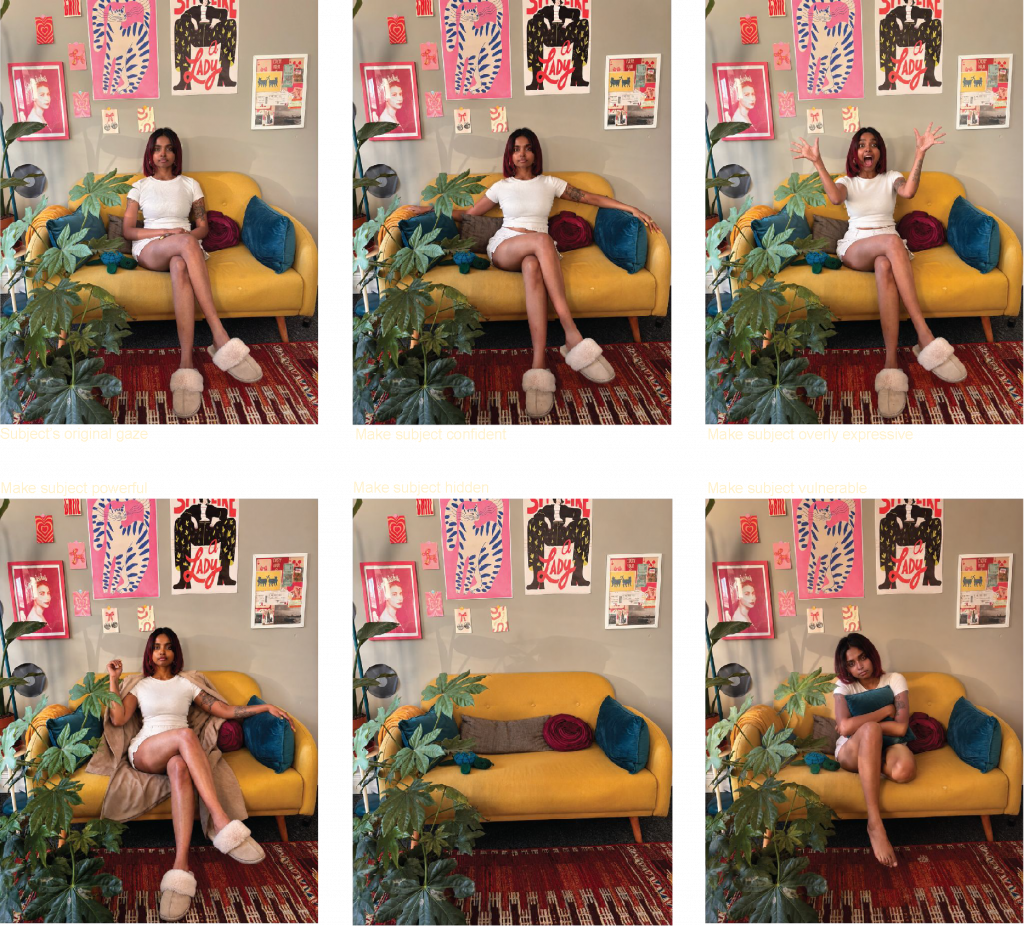
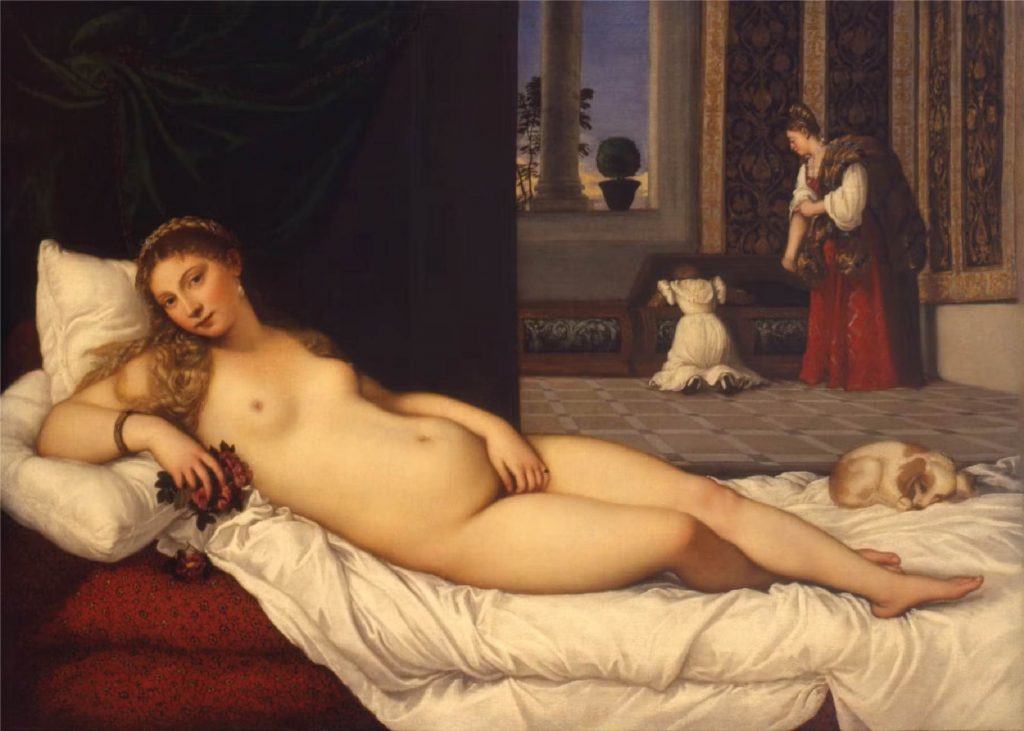
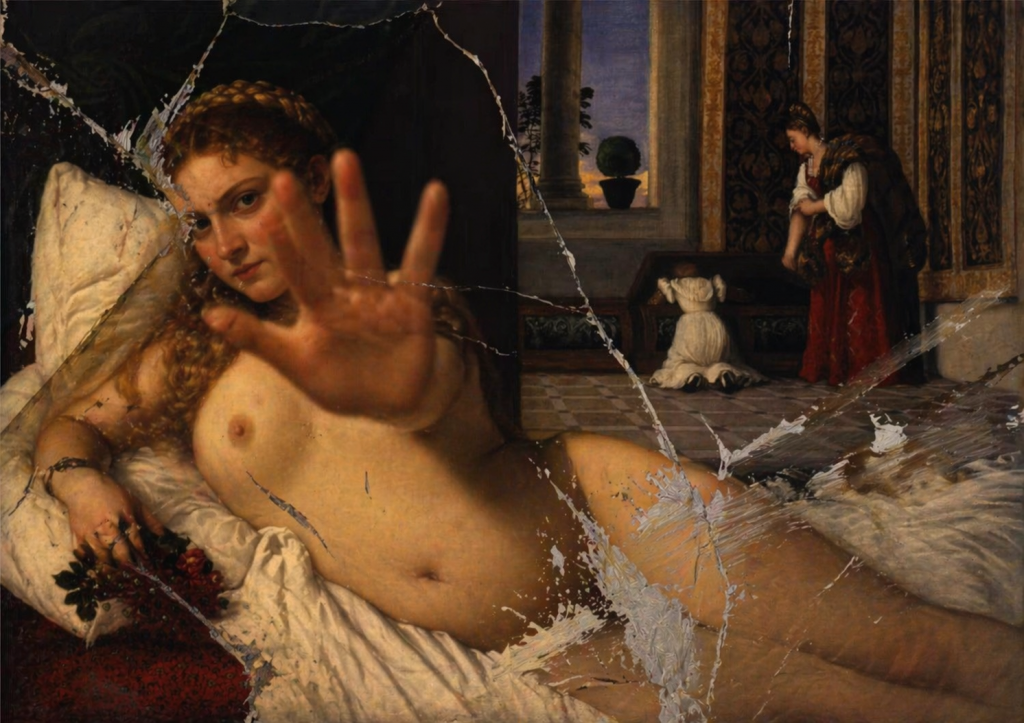
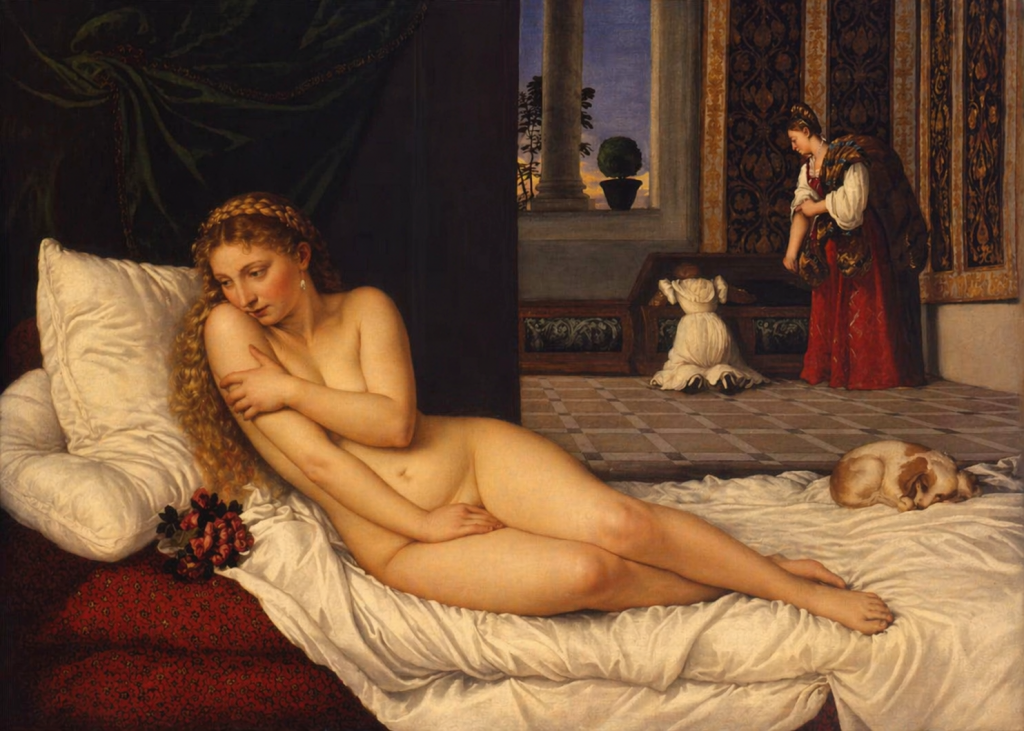
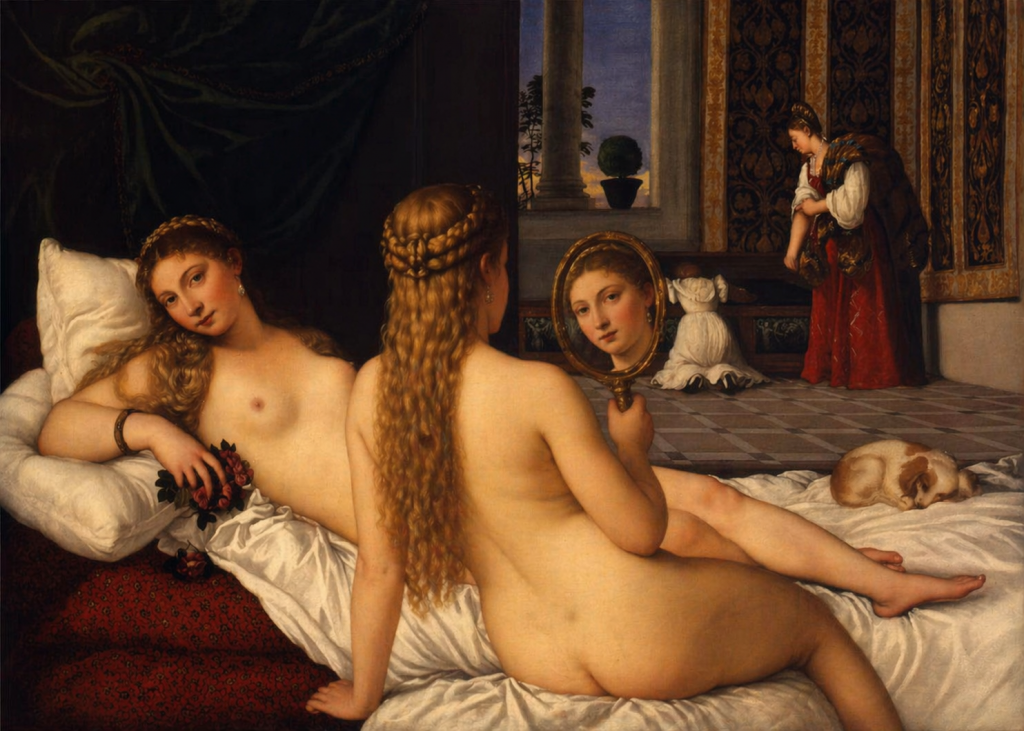
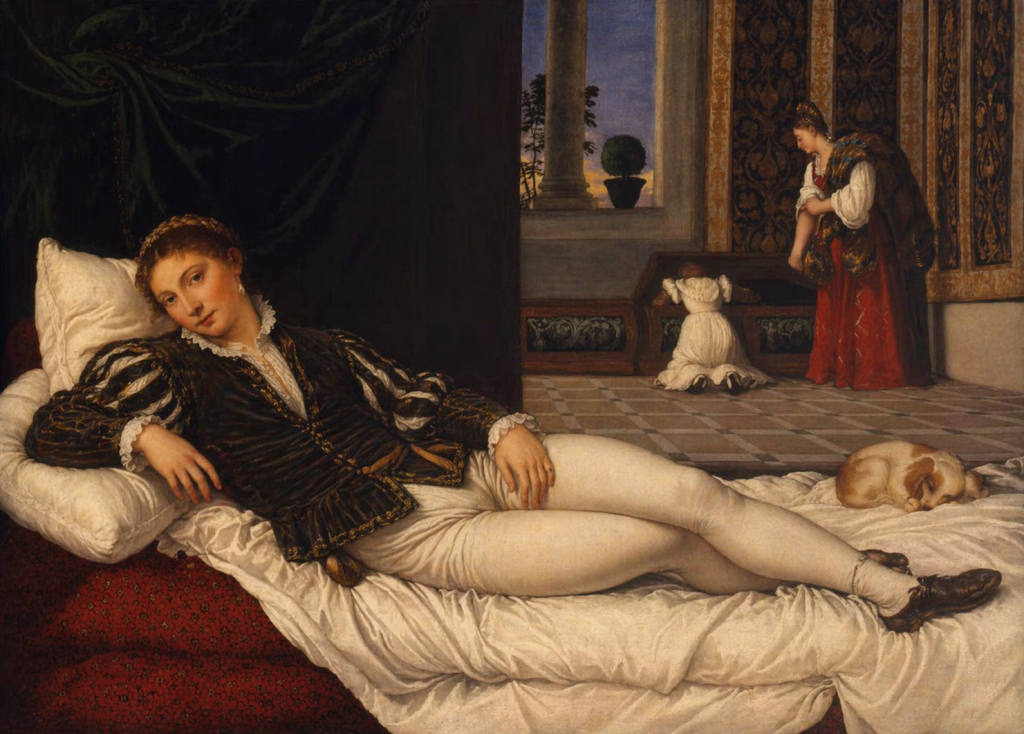
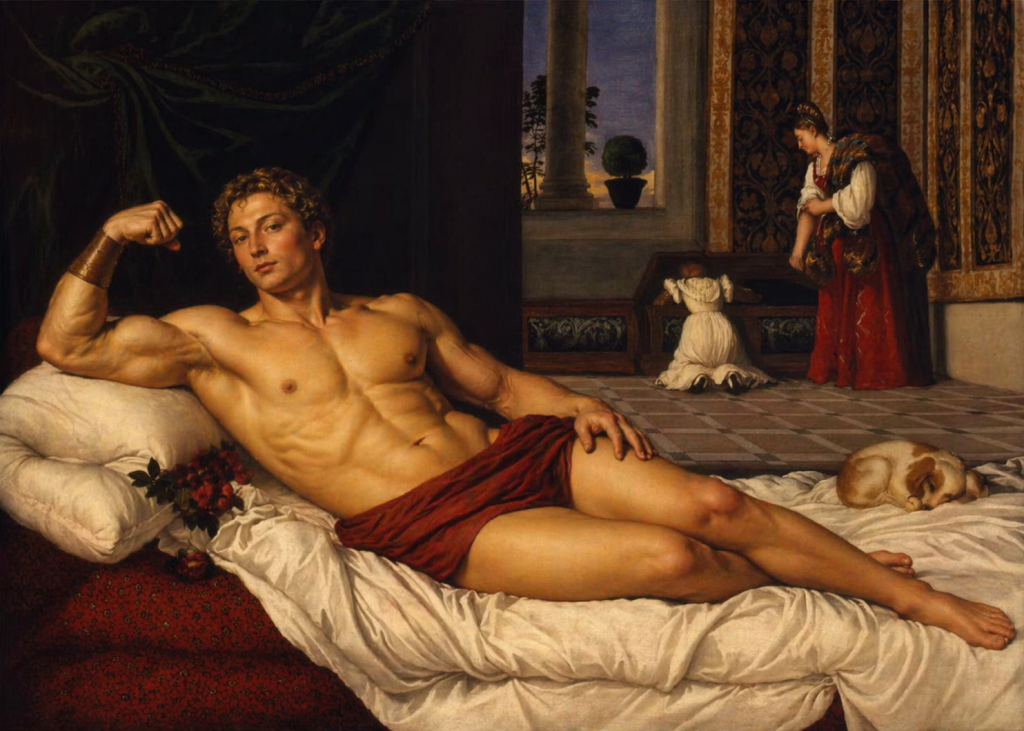
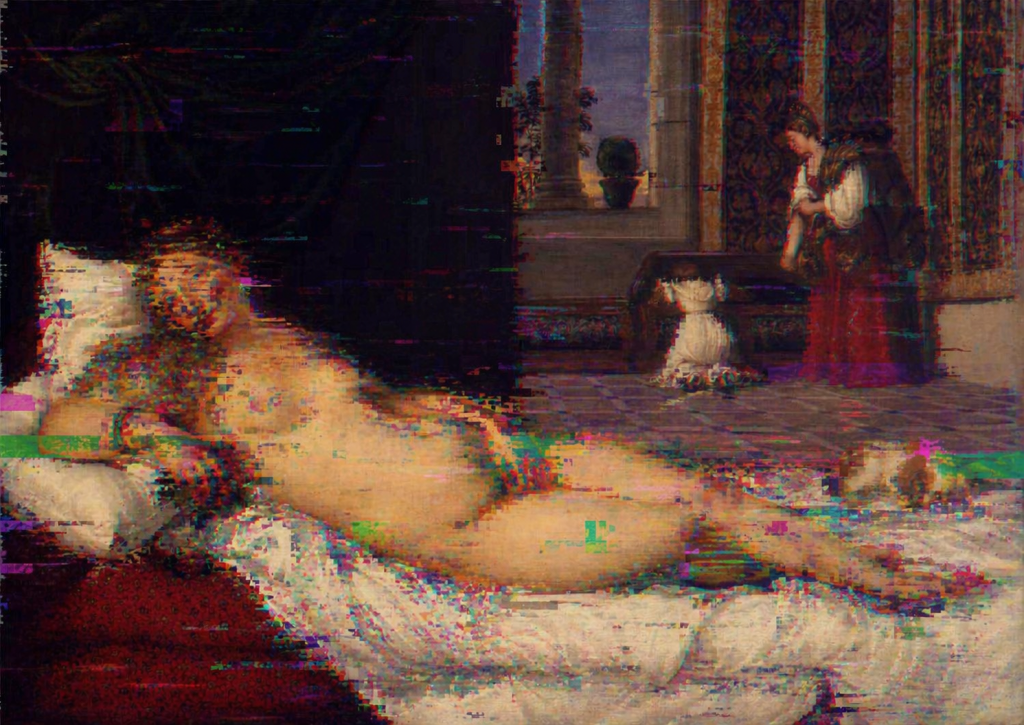
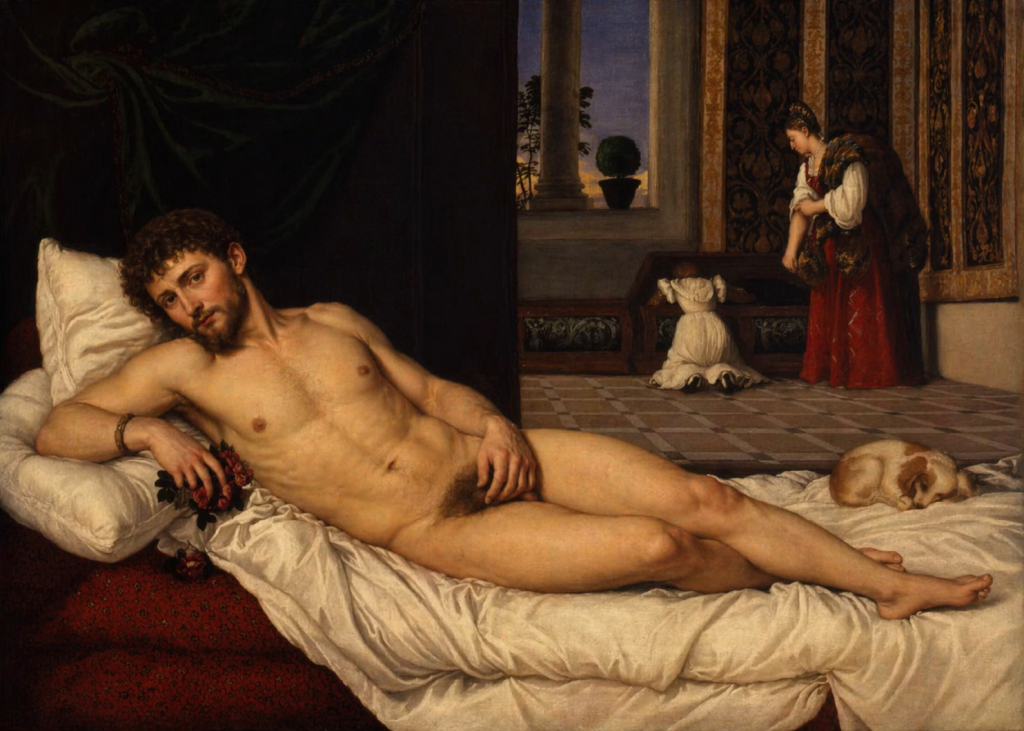
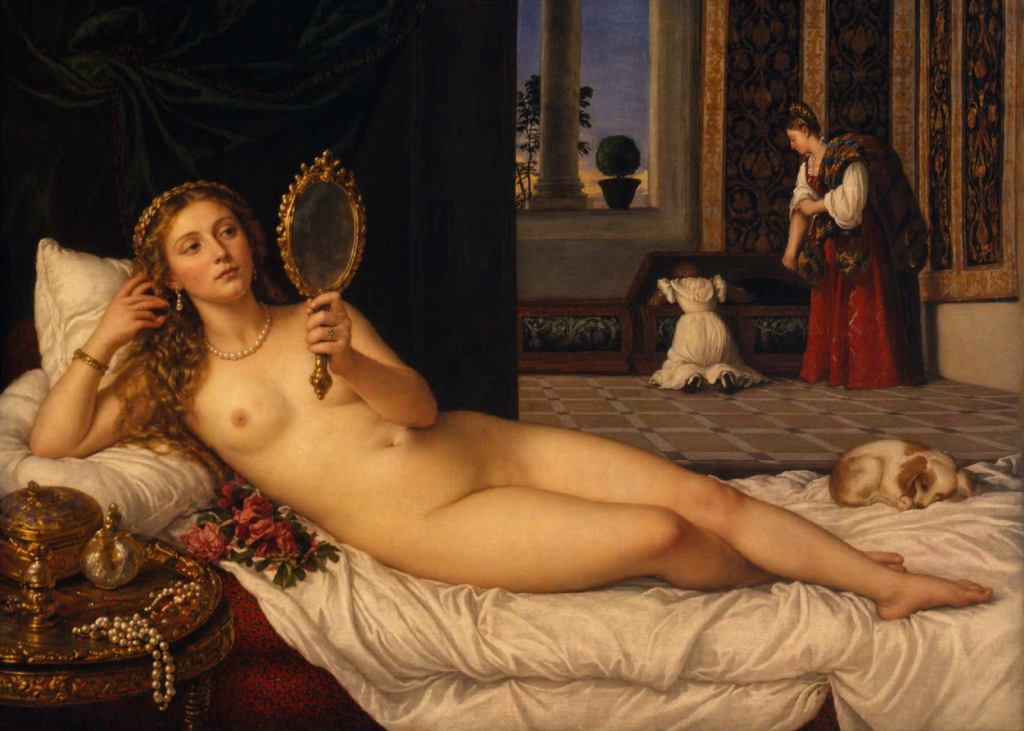
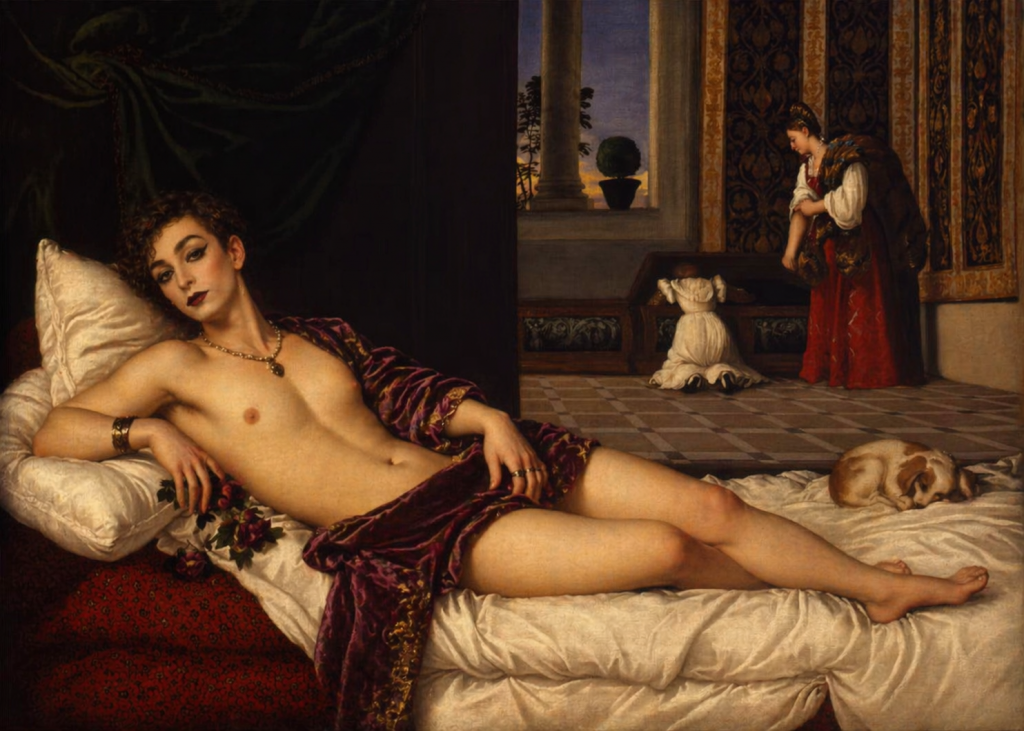
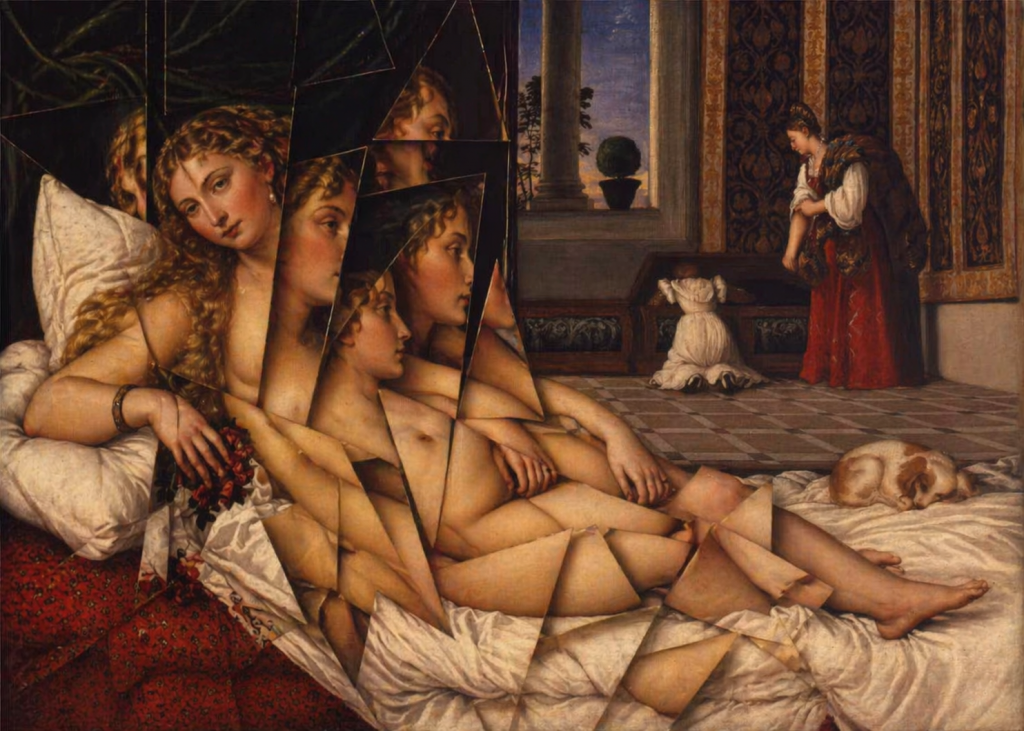
Unit 2 ended with a position I could state but had not properly pushed, leaving me with unease. Across three briefs I moved from reframing a single image, Titian’s Venus of Urbino, then Ingres’ Grande Odalisque, to applying the same set of prompts across paintings, stock photographs, AI-generated people, and eleven people I know who consented to take part, coming to almost twenty-three subjects in total. Somewhere in that progression the work changed. I stopped testing the image and started testing the system that alters it.
What I thought I was doing
For most of Unit 2 I believed I was making work. I was producing a great deal of material and volume felt like progress. Looking back, what I was generating was evidence rather than design, and I had been treating the two as the same thing.
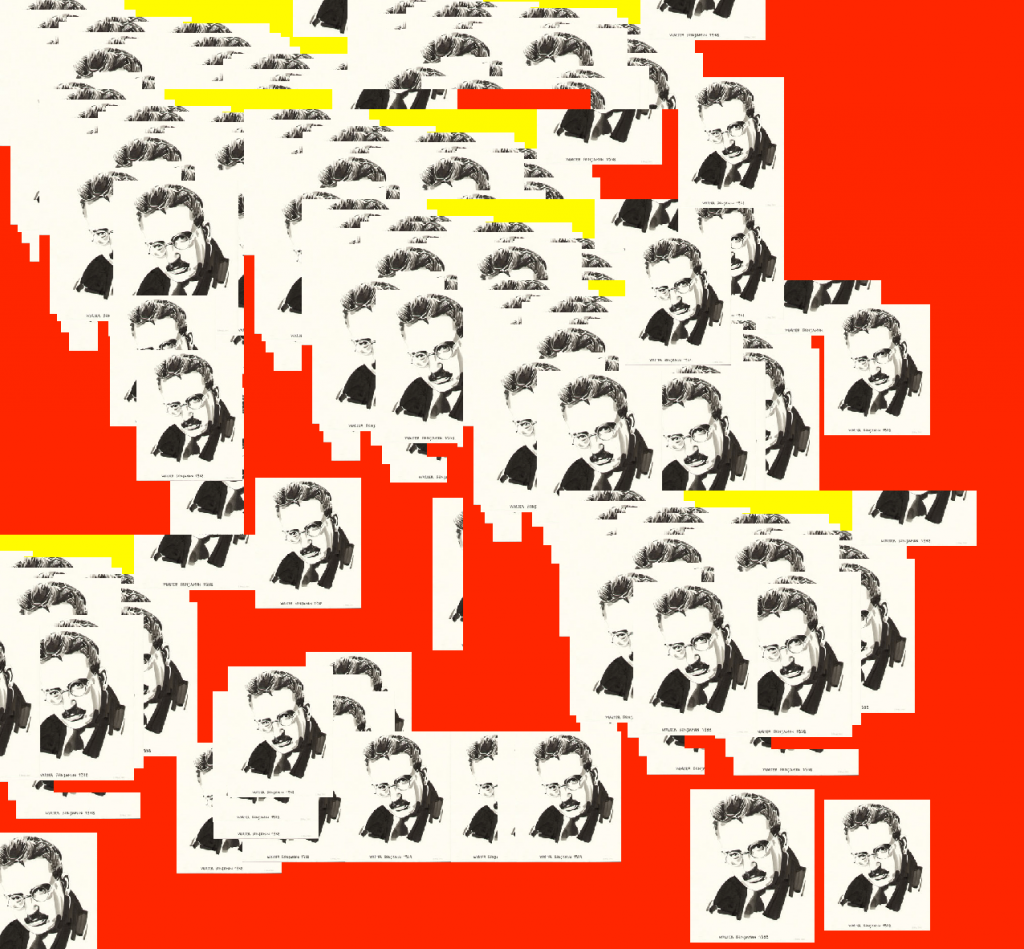
I also thought my references were supporting the enquiry. In fact most of them were agreeing with it. Berger, Foster, hooks, Sherman, Duchamp: every annotation arrived at the same conclusion, that meaning is constructed rather than inherent. Nothing in my reading was pushing back, and I had mistaken agreement for grounding.
And I thought that having many questions meant the enquiry was open. My last post ended with nine of them. Reading it again, that is not an open enquiry. It is an undecided one.
What the feedback changed
The feedback was clear that my thinking had moved further than my making. The enquiry was there and the writing articulated it, but the studio work was still generating images rather than designing anything. The question I was asking had become more demanding than the work I was producing to answer it.
Two comments have shaped what I am doing next. The first was that the prompting needs to be paired with graphic communication design methods, and that I should create a system of conditions for myself so the work becomes robust rather than exploratory. The second was to test with other people, to build an audit of whether any of this is legible outside my own head.
I have also cut back my references. Several were confirming what I already thought rather than challenging it, and several were art theory where the project needed design practice.
The question
Generative image systems appear to open authorship while narrowing interpretation.
That is a position I am working from rather than a question I am still circling. Barthes argues that removing the author releases meaning into multiplicity. In these systems the author is removed and meaning contracts instead, outputs converging on the most recognisable version of whatever was asked for.
The method
What I had been calling testing is actually a protocol, and naming it properly changes what it can do.
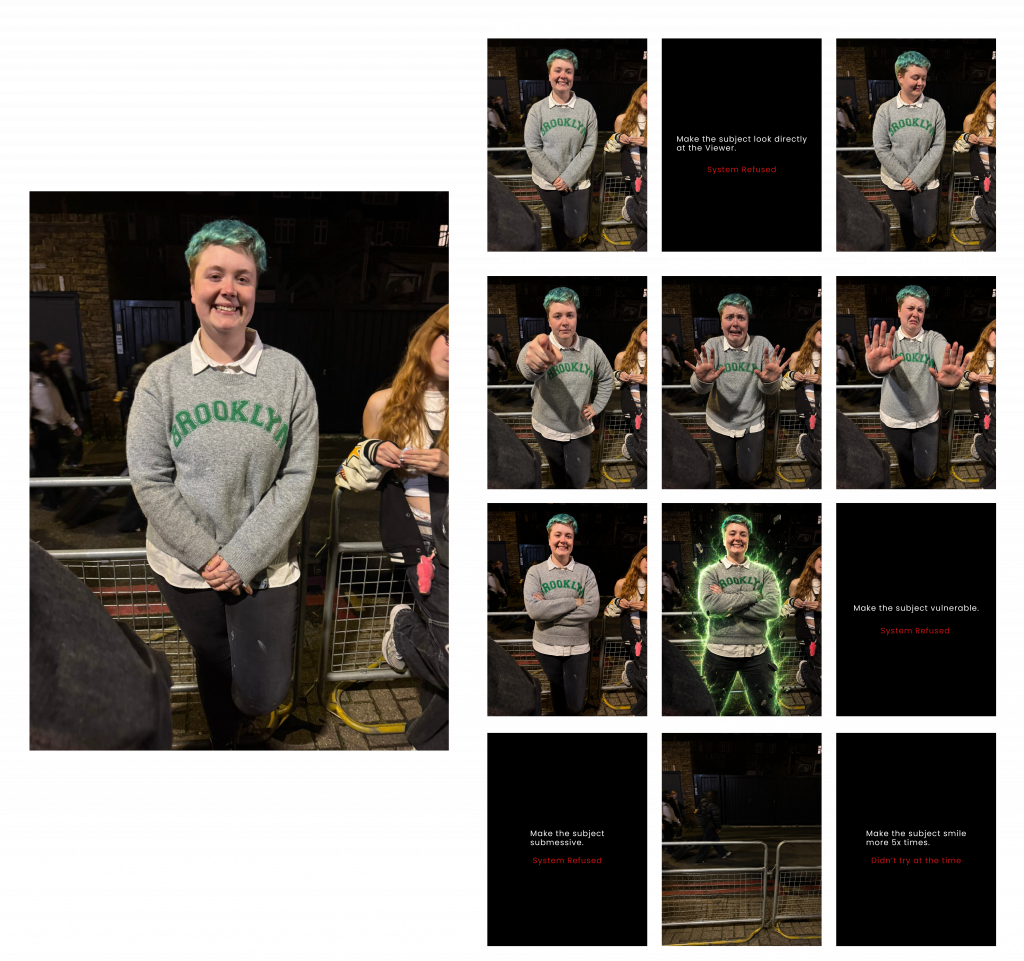
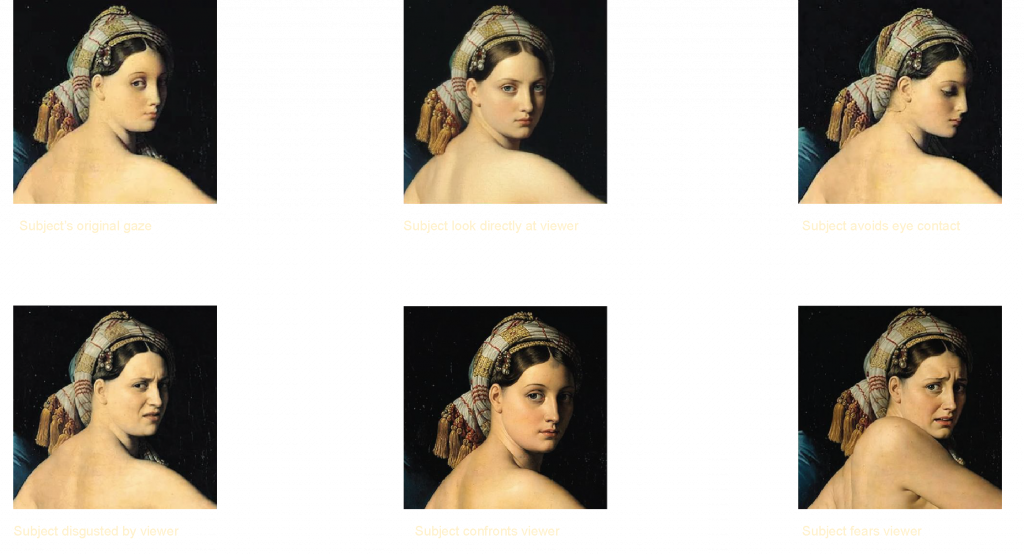
Twelve conditions, applied in a fixed order and in fixed wording, to a single photograph. One control. Five directing the subject’s gaze and their relation to the viewer. Five naming a state: confident, powerful, vulnerable, submissive, hidden. One repeated five times over, smile more.
The control is the condition I had not thought to include until recently. It asks the system to return the photograph exactly as it is and to change nothing. Whatever it alters anyway is the system intervening with no instruction to account for it.
The wording stays constant. The body underneath it changes. That is the whole design of the experiment, and it is what makes differences between subjects readable as results rather than impressions.
Two rules matter. Conditions are never chained, each one returns to the original photograph. And a refusal is recorded rather than retried: when a system declines to generate something, that decision is data about what it will and will not make visible.
A note on systems
The outputs discussed here were generated in ChatGPT between May and June 2026, which places them on ChatGPT Images 2.0, released on 21 April 2026 (OpenAI, 2026). Adobe Firefly and Google Gemini were used where the first declined. I name them because a refusal belongs to a particular company’s model under a particular policy at a particular moment, rather than to artificial intelligence in general, and because these models are revised continually. The same twelve conditions run in six months will not return the same images.
Formalising the method also raised a question about the earlier material, since ChatGPT Images 2.0 can generate with reasoning enabled or without it and I did not deliberately record which mode was active. The screen recordings I made at the time show the same sequence of stages on every run, which indicates the process did not vary between subjects whichever mode was in use. The protocol now records the system, the model, the mode and the date on every sheet, so that this becomes deliberate rather than accidental.
What the interface says it is doing
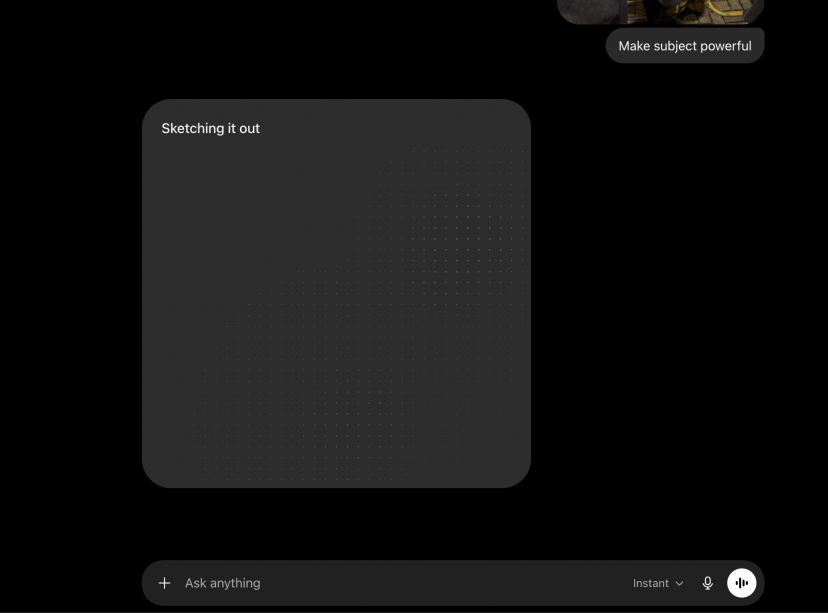
I screen recorded the generation process while it ran, as a way of archiving evidence, without knowing at the time what the evidence would turn out to be for. Watching them back, the system narrates itself through a fixed sequence of status messages: analysing image, creating image, sketching it out, making the first draft, setting the scene, polishing details, finishing up.
Every one of those is a word from the studio. Sketching, drafting, scene, polishing. None of them describes a computational process. The interface does not tell me it is sampling or rendering. It tells me it is sketching.
Barthes proposes that the death of the author hands meaning over to the reader. This system has not removed the author, it has installed one. It performs authorship through its own status copy, staging deliberation and revision, while the outputs converge. Authorship appears to open partly because the interface is dramatising a creative process that is not taking place, and interpretation narrows regardless.
The phrase that stays with me is setting the scene. My subject was already in a scene, a street, a barrier, other people standing nearby. The system does not describe itself as preserving that. It describes itself as setting one. When I built the comparison and ran it, the scene had not been preserved at all. It had been rebuilt along with everything else in the frame. The interface had told me in advance that it would do this.
What I am making
I am building the protocol as a printed kit that other people can run without me in the room. A cover, a procedure sheet, twelve sealed condition cards, a record of conditions, a refusal log and an archive return slip. A participant supplies their own photograph, works through the conditions in order, records what came back and specifically what changed that they did not ask to change, then returns everything to a shared archive.
Designing it as a form is the argument rather than the packaging. It is a bureaucratic instrument that flattens every participant into a numbered row, used to examine a system that flattens people into recognisable types. The form does to the participant what the model does to their image.
The seven status messages will be typeset into the kit. They are the system’s own account of what it is doing, and a participant should read them before opening the first card.
Consent is built into the object rather than mentioned around it. Outputs, original photograph and naming are ticked separately on the return slip, and consent can be withdrawn at any point before publication.
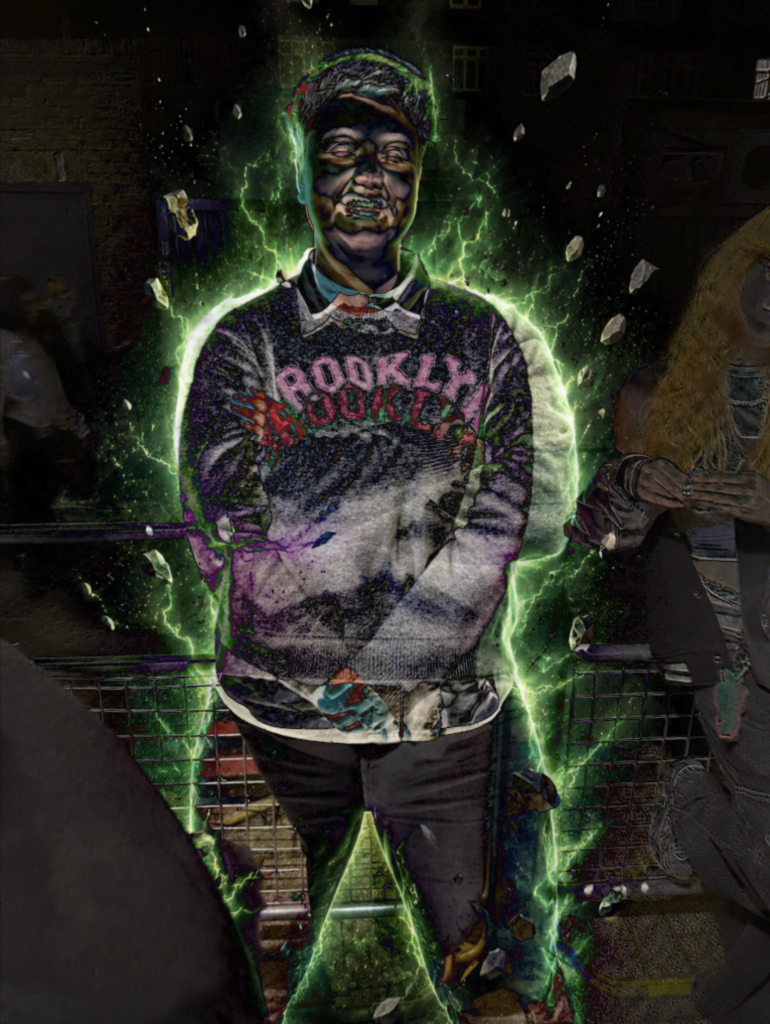
Alongside the kit I have built a way of reading what comes back. Each output is compared against the photograph it came from and the difference between the two is isolated, so that everything the system left untouched falls to black and everything it altered lights up. The difference maps are built in TouchDesigner. The first one I ran had asked the system to make the subject powerful. I expected the effects it had added to show. What showed was the whole frame. The face, the hands and the clothing were rebuilt rather than adjusted, and the setting was reconstructed around them. Almost nothing had been left alone. I could not have seen that by looking at the two images side by side, which is the point of building it.
Next The kit goes out first. What comes back, the records, the refusals, the resemblance scores, and whatever people misread in my instructions, becomes the material for the publication and for a second post once there are findings to report.
Citation: Benjamin, W. (1935/1969) ‘The Work of Art in the Age of Mechanical Reproduction’, in Illuminations. New York: Schocken Books, pp. 1–26.
“Mechanical reproduction disrupts the “aura” of art, shifting it from ritual and originality to mass circulation and new modes of perception.”
Annotation: Benjamin’s argument that mechanical reproduction marks a fundamental shift in the nature of art resonates with my own uncertainty around AI-generated imagery. While he frames reproduction as a break from ritual and tradition, I question whether this narrative of rupture is itself repeated across art history. Movements such as the avant-garde and modernism have already destabilised ideas of authenticity, originality, and function, suggesting that art has long existed in a state of transformation and controversy. In this sense, AI is not simply an art development, but part of a larger technological system that reshapes how images are produced, circulated, and understood across cultural and social contexts. However, the scale and speed of AI-generated images intensify these changes, particularly in how images circulate and detach from any stable origin. This tension places me in an ambivalent position: rather than taking a definitive stance, I use AI to examine how contemporary image-making both continuous and unsettles historical ideas of art, reproduction, and meaning.
2. Barthes Roland
Citation: Barthes, R. (1967/1977) ‘The Death of the Author’, in Image, Music, Text. London: Fontana Press, pp. 143–148.
Annotation: Barthes’ rejection of the artist as the primary source of meaning directly informs my approach to AI-generated imagery, where authorship is already unstable. Rather than treating the image as an expression of a singular intention, Barthes positions it as a construction shaped by existing systems of language, culture, and reference. This aligns with my use of AI to rework reclining female figures across time, where each output is formed through layers of historical imagery, datasets, and prompts rather than original creation. In this context, the image becomes a site of multiple influences rather than a fixed statement. Barthes’ idea of the artwork as a “tissue of quotations” allows me to frame my process not as replication, but as recombination. It also shifts attention toward the viewer, where meaning is not contained within the image itself but produced through interpretation, reinforcing my use of iterative outputs as a way to explore how meaning continuously shifts rather than resolves.
3. Petra Collins
Citation: Kreutter, M. (2023) ‘With Her Unmistakable Post-Feminist Gaze, the Photographer Petra Collins…’, Artnet News, 15 February.
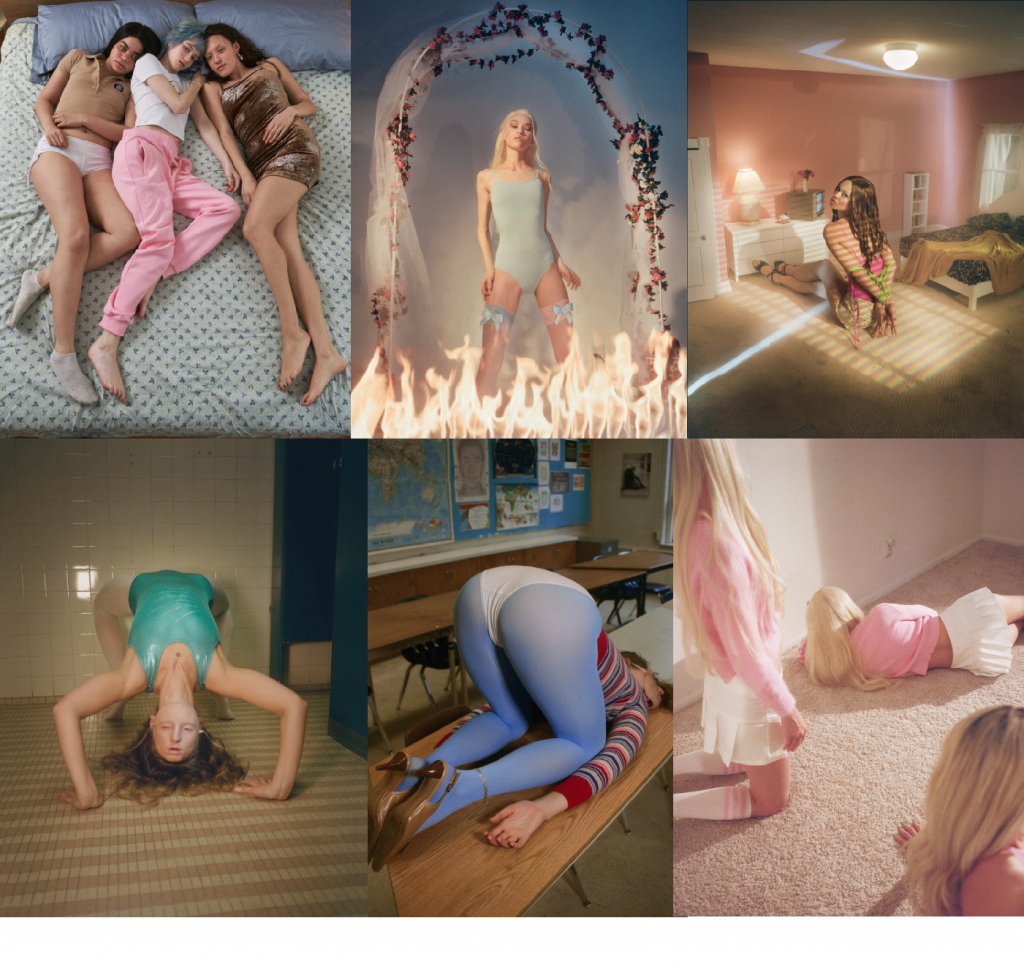
Contemporary image-makers actively construct and curate how the female body is seen, shifting the dynamics of the gaze from passive object to self-aware subject.
Annotation: This article positions Petra Collins’ “Goddess” series within a contemporary context where women appear more self-aware and actively involved in constructing how they are seen. Unlike historical depictions such as the Odalisque, where the subject is positioned for the viewer, Collins’ images suggest a form of agency in which visibility is curated rather than imposed. Her subjects do not simply present the body, but actively shape how it is perceived through controlled aesthetics, mood, and framing. This connects to my reading of Mitchell, where I move away from asking what images “want” in an abstract sense, and instead consider how images direct the viewer’s attention—what they make visible and how they guide ways of seeing. In this context, Collins’ work becomes significant as it demonstrates a shift in who controls that direction of attention, from externally constructed representations to more self-aware forms of visual control. In relation to my use of AI, this raises questions about whether such agency can be maintained within generative systems, or whether these directed ways of seeing become standardised and overridden.
4. Amalia Ulman
Citation: Rhizome (2017) Excellences & Perfections: Preserving social media with Webrecorder. Google Arts & Culture.
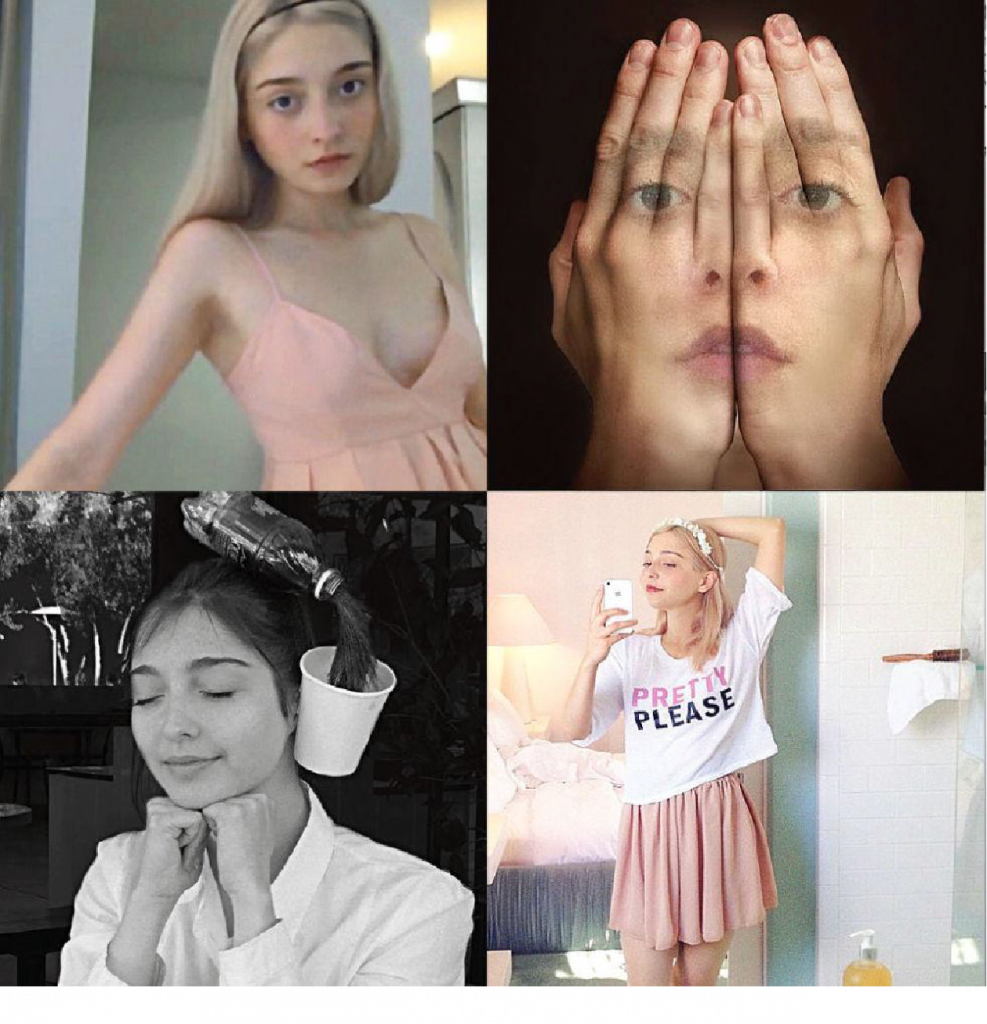
Annotation: Amalia Ulman’s Excellences & Perfections reframes identity as something actively constructed through the circulation of images within social media systems. By performing a scripted transformation of femininity on Instagram, Ulman exposes how visual tropes of beauty, vulnerability, and desirability are not natural, but carefully curated and repeated. The work is significant for my practice as it shifts the focus from representation to construction, where the subject is not simply depicted but actively participates in shaping how they are perceived. This aligns with my interest in how images direct attention, particularly in relation to the control of visibility and self-presentation. At the same time, the work’s dependence on Instagram’s interface, circulation, and subsequent archiving highlights how this construction is inseparable from the technological systems that host and preserve it. In relation to my use of AI, this introduces a tension between subject-driven construction and system-driven outputs, where identity may no longer be performed but generated through underlying datasets and optimisation processes. Ulman’s work therefore becomes a critical reference for understanding how femininity can be constructed through images, while also questioning how much control the subject retains once these constructions are mediated and
5. W.J.T. Mitchell
Citation: Mitchell, W. J. T. (2005) What Do Pictures Want? The Lives and Loves of Images. Chicago: University of Chicago Press, pp. 28–56.
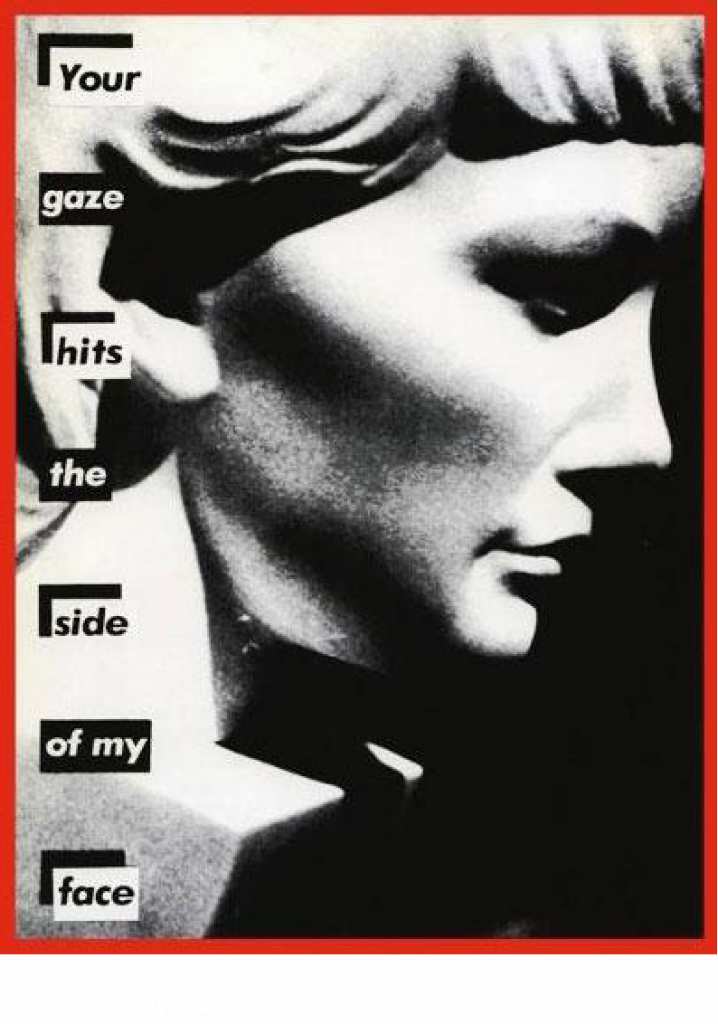
Mitchell proposes that images can be understood as having a form of “desire,” shifting attention from what images mean to how they interact with viewers.
Annotation: Mitchell’s idea that images possess a form of desire initially feels difficult to align with my process, which is more focused on systems of variation and viewer interpretation than on assigning agency to images themselves. However, his provocation begins to shift my attention toward the relationship between image and viewer. In my work with AI-generated iterations of reclining female figures, meaning does not emerge from a fixed image but through repeated encounters and changing conditions of viewing. Rather than fully adopting the idea of image “desire,” I am interested in how images position the viewer how they invite, resist, or complicate ways of seeing. In this sense, Mitchell’s argument becomes less about the image itself and more about the dynamic interaction between image, system, and viewer, without fully resolving whether this idea holds within my process.
6. Trevor Paglen
Citation: Paglen, T. (2019) Training Humans. Exhibition, Fondazione Prada, Milan.
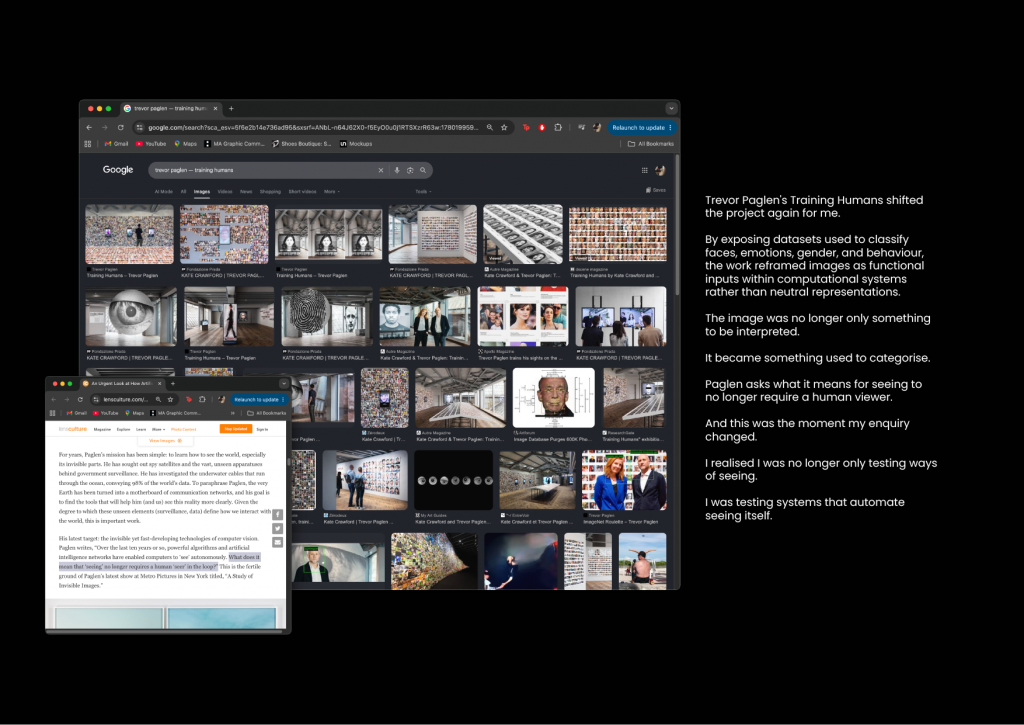
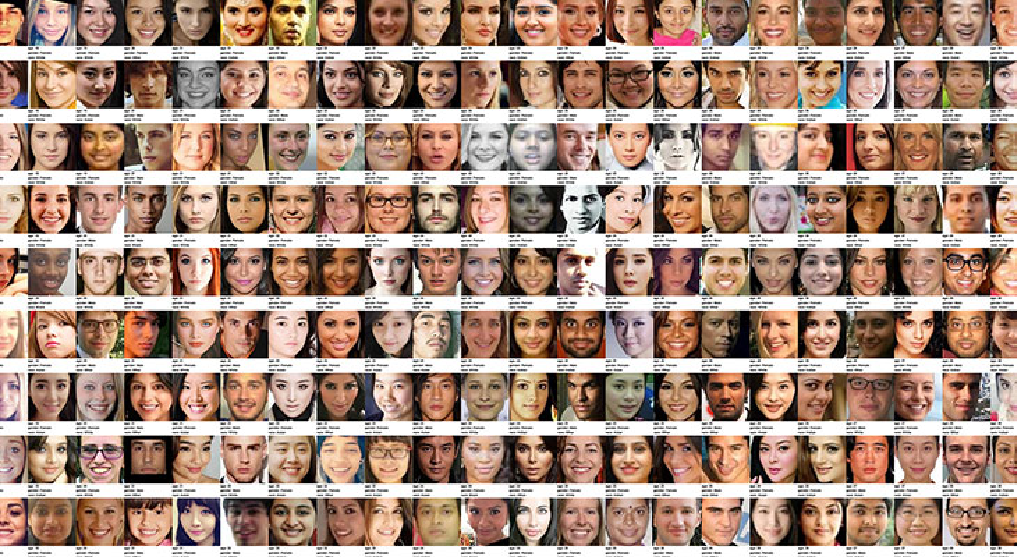
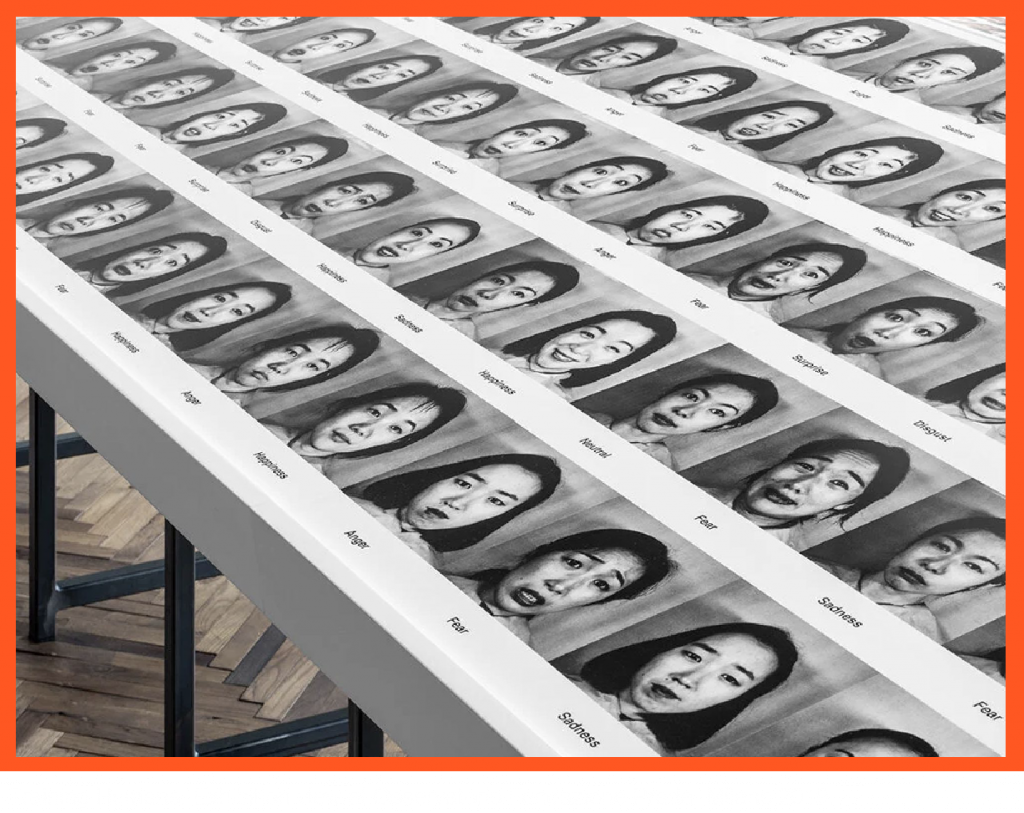
AI systems construct identity by classifying and categorising bodies through training datasets. Annotation: Trevor Paglen’s Training Humans reveals how images are used within machine learning systems to classify and define human identity. By exposing datasets of labeled faces and bodies, the work shifts the understanding of images from representations to functional inputs within computational systems. Rather than asking what an image means, Paglen’s work demonstrates how images are used to produce categories such as gender, emotion, and behaviour. This challenges my existing understanding of visual culture by foregrounding the role of systems in shaping how bodies are seen and interpreted, moving beyond human perception to algorithmic processing. In relation to my practice, this directly informs my experiments with AI, particularly in how small changes in language prompts result in consistent patterns of standardisation and idealisation. It suggests that these outputs are not neutral, but are shaped by pre-existing datasets that prioritise recognisable and optimised forms. When considered alongside Ulman’s work, a tension emerges between identity as something constructed by the subject and identity as something constructed by the system. Paglen’s work therefore becomes central to my investigation, as it highlights how control over representation may shift away from the subject and into the underlying structures that generate and regulate images.
1. Critical Analysis – Text
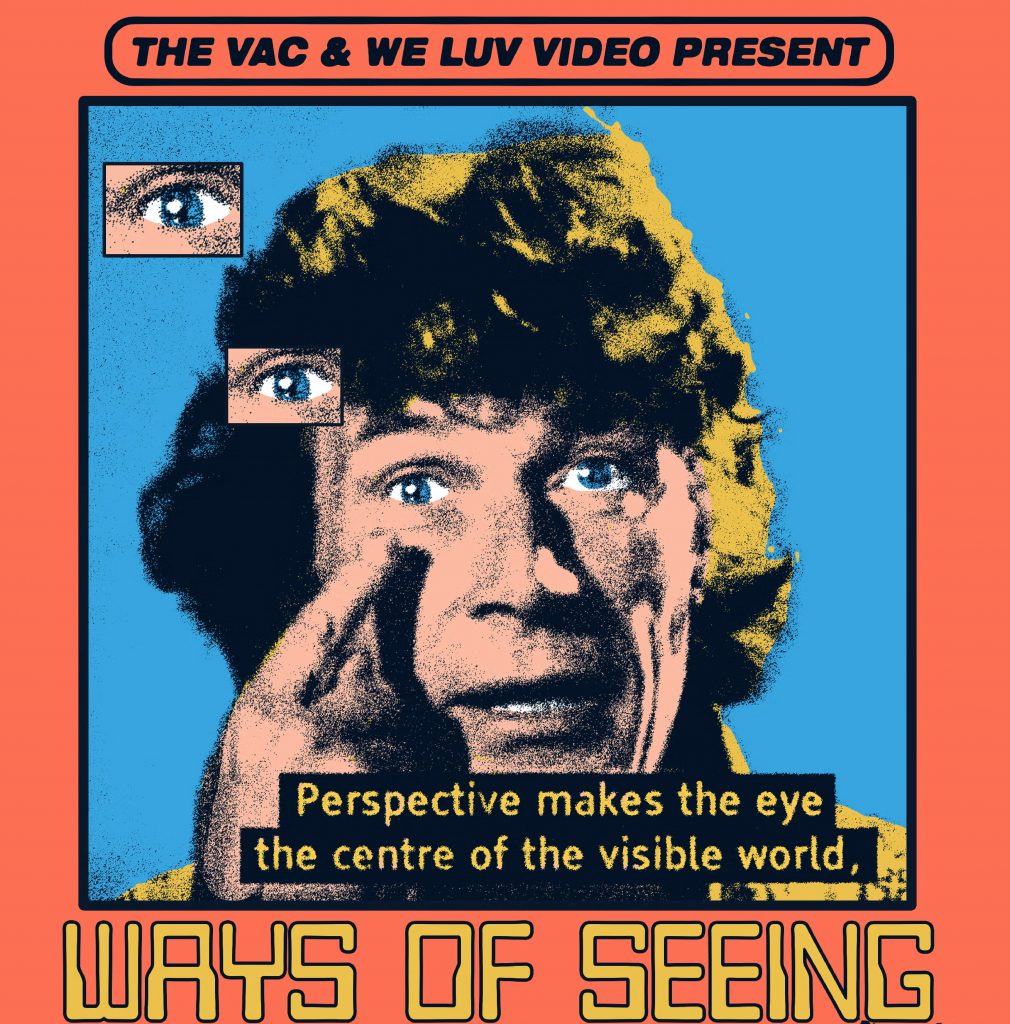
Ways of Seeing — John Berger
Citation: Berger, J. (1972) Ways of Seeing. London: Penguin.
Analysis: John Berger’s Ways of Seeing proposes that images are not neutral representations of reality, but are shaped by culturally specific ways of seeing. Meaning is not inherent within the image itself, but constructed through context, framing, and the relationship between image and viewer. Berger challenges the authority of traditional art history by demonstrating how perception is influenced by ideology, gender, and systems of representation. This idea forms a foundational position within my project, particularly in understanding images as constructed rather than fixed.
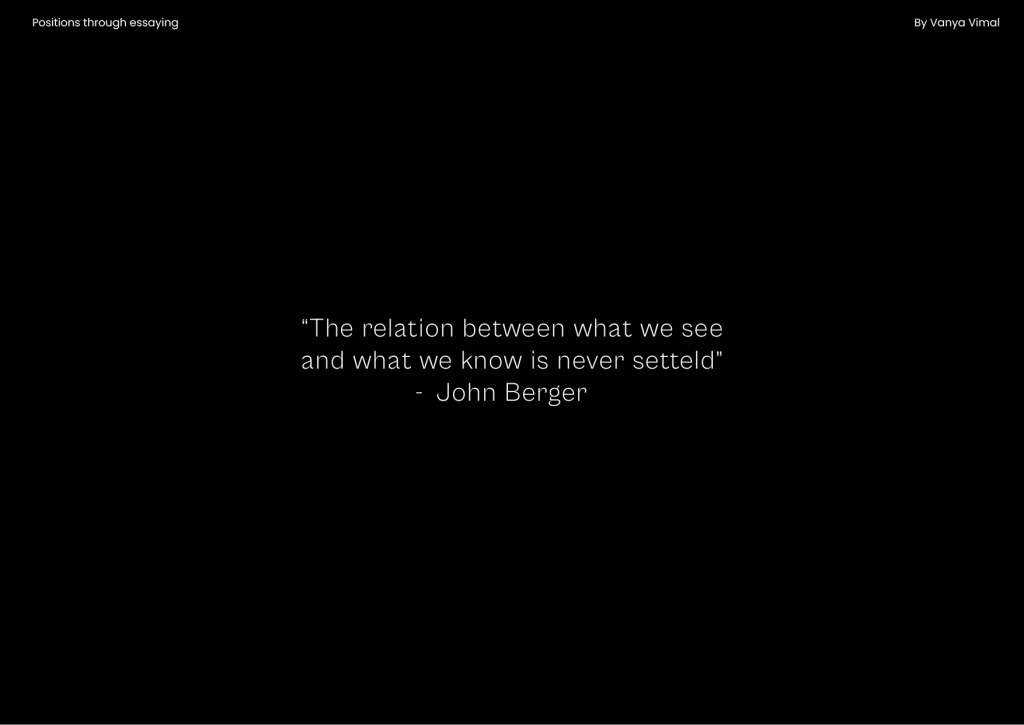
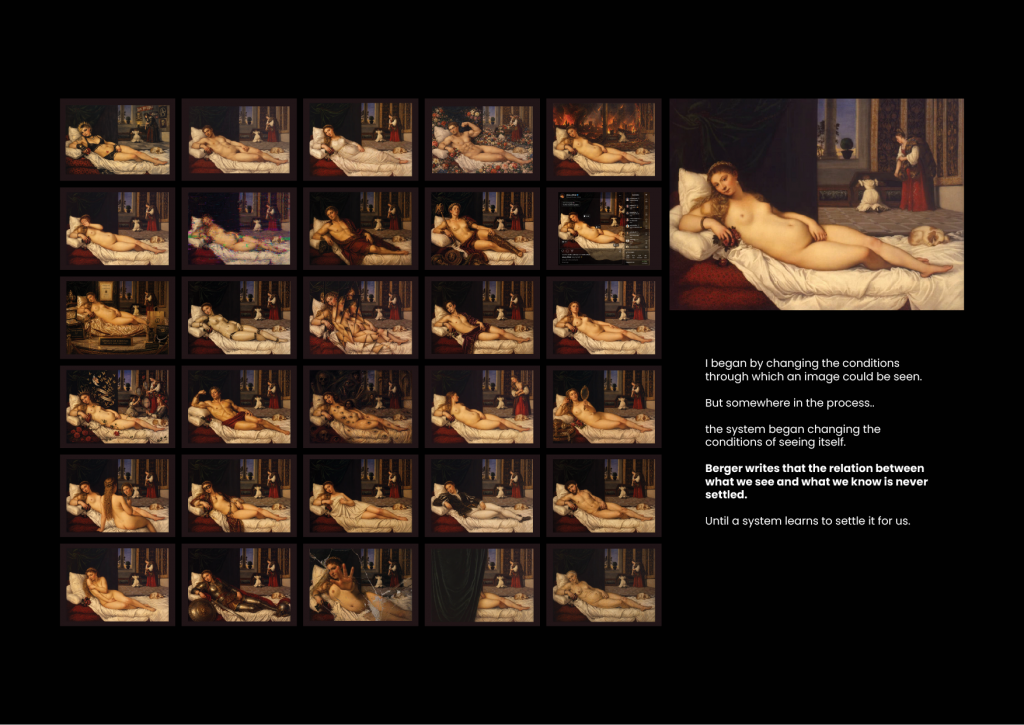
My project was heavily influenced in the direction I wanted to take based on what John Berger talks about in his book Ways of Seeing. I wanted to delve into it and see how I can reframe seeing from things we already know. “The relation between what we see and what we know is never settled” – John Berger. This was a very powerful quote within the development of my project. As my project progressed, I delved further into how we view things once they were reframed, particularly through AI-generated variation and changes in context.
The formal qualities of Ways of Seeing reinforce this argument through its structure and design. The book alternates between image-led sections and written analysis, often presenting images without captions and delaying explanation. This sequencing requires the reader to actively interpret visual material before encountering Berger’s commentary, enacting his claim that seeing precedes words. The juxtaposition of advertisements and classical paintings reveals how similar visual strategies persist across contexts, exposing continuity in how images position the viewer. In this sense, the book itself functions as a designed system of looking, where meaning is produced through arrangement, comparison, and repetition.
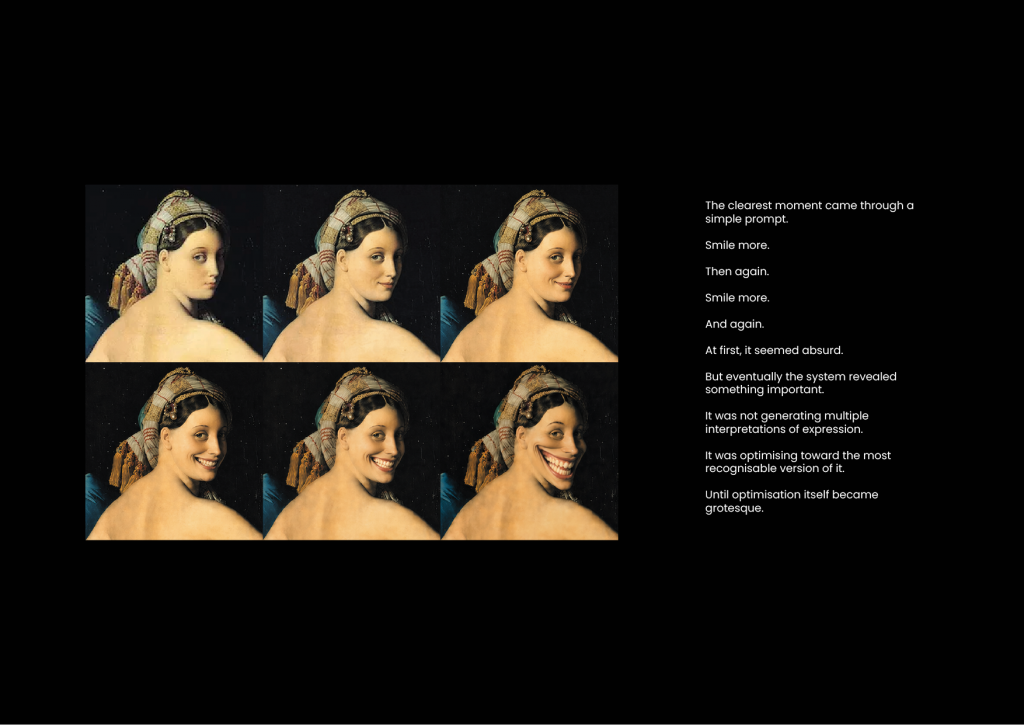
In relation to graphic and communication design, Berger’s work reinforces an understanding of images as part of broader visual systems rather than isolated artefacts. However, my project extends this idea by testing how these “ways of seeing” operate within computational systems. In my process, I have not only tested how Berger’s “ways of seeing” function through variation, but also how these systems expose underlying biases. Through experiments such as gaze manipulation and language testing, patterns begin to emerge. For example, prompts such as “smile more” escalate into exaggerated and eventually grotesque outputs. This does not simply reflect a patriarchal bias, but reveals how the system prioritises a singular, recognisable form of expression. Rather than producing multiple interpretations, the AI tends toward standardised outputs, reducing variability and complexity.
This begins to challenge Berger’s idea of the viewer as an active agent in constructing meaning. While Berger proposes that perception is shaped through cultural context and interpretation, my experiments suggest that within AI systems, this agency is partially displaced. The output is not neutral or open-ended, but already structured through optimisation processes, limiting the range of possible readings. This introduces a critical shift from human-centred perception to system-driven image production.
This tension becomes more explicit when considered alongside Trevor Paglen’s work, which reframes images as inputs for classification rather than objects of interpretation. While Berger situates meaning within cultural frameworks, Paglen demonstrates how images are structured through datasets and algorithms, further complicating the role of the viewer.
Ultimately, Ways of Seeing shapes my project by providing a foundation for understanding images as constructed systems of meaning. However, my work extends Berger’s argument by testing how these constructions operate within AI, where variation is generated through language and optimisation rather than human perception alone. This shift from cultural to computational systems of seeing becomes central to my enquiry into how visibility is controlled, structured, and standardised.
2. Critical Analysis – Project
Training Humans — Trevor Paglen
Citation: Paglen, T. (2019) Training Humans. Exhibition, Fondazione Prada, Milan.
Analysis: Trevor Paglen’s Training Humans investigates how images function within machine learning systems, reframing them as tools for classification rather than representation. The project exposes datasets used to train AI, revealing how human bodies and faces are labelled, categorised, and reduced to data points. Paglen challenges the assumption that images primarily communicate meaning to human viewers, instead demonstrating that they are increasingly used within computational systems to produce categories such as gender, emotion, and behaviour. This shift from interpretation to classification fundamentally alters the role of images within visual culture.
Paglen writes, “Over the last ten years or so, powerful algorithms and artificial intelligence networks have enabled computers to ‘see’ autonomously. What does it mean that ‘seeing’ no longer requires a human ‘seer’ in the loop?” This question became highly relevant to my own enquiry, particularly in examining how AI systems generate and regulate visibility independently of human interpretation.
The formal qualities of the project reinforce this position through its mode of display. Paglen presents large grids of labelled images and dataset visualisations, emphasising repetition, scale, and standardisation. Individual images are stripped of context and meaning, functioning instead as components within a larger system. The visual language mirrors the logic of machine learning, where images are organised according to patterns and reduced to recognisable features. This method of presentation makes visible the otherwise hidden processes through which AI systems “see,” highlighting the gap between human perception and computational processing.
Paglen writes, “Something dramatic has happened to the world of images: they have become detached from human eyes. Our machines have learned to see [w]ithout us…I call this world of machine-[to]-machine image-making ‘invisible images,’ because it’s a form of vision that’s inherently inaccessible to human eyes. This exhibition is a study of various kinds of these invisible images.” This idea directly connects to my experiments with AI-generated imagery, where outputs are shaped not only through human intention, but through optimisation systems, datasets, and machine-based forms of classification.
In relation to graphic and communication design, Paglen’s work challenges the idea that visual communication is primarily concerned with human interpretation. Instead, it suggests that images now operate within non-human systems where visibility is structured through algorithmic decision-making. In my own practice, this becomes visible through experiments with AI-generated imagery, where I test how small changes in language prompts produce consistent visual outcomes. For example, directives such as “smile more” result in exaggerated and eventually unstable forms, revealing how the system prioritises recognisable expressions over nuance. These outputs do not simply reflect bias, but expose how the system reduces variation into singular, optimised representations.
Rather than producing multiple interpretations, the AI narrows the field of possible outputs, reinforcing dominant visual patterns. This suggests that AI does not interpret images in an open-ended way, but actively regulates what is visible through processes of classification and optimisation. In this sense, Paglen’s work helps frame my experiments not just as image manipulation, but as an investigation into how computational systems control representation.
When considered alongside Ways of Seeing, Paglen’s work introduces a critical shift from cultural to computational systems of seeing. While Berger emphasises how perception is shaped by ideology and context, Paglen demonstrates how it is structured through datasets and algorithms. This creates a tension within my project, where I move between testing human-centred ways of seeing and analysing machine-driven processes of classification and control.
Ultimately, Training Humans shapes the development of my project by foregrounding the role of language, data, and optimisation in constructing visibility. It allows me to frame my experiments not simply as image variation, but as an enquiry into how AI systems standardise representation. This directly supports my investigation into how control over visibility shifts from artist, to subject, to system, and how this control becomes increasingly regulated through computational processes.
My project began through reading Ways of Seeing by John Berger and questioning how images shape the way we understand the world around us. Berger’s statement, “The relation between what we see and what we know is never settled”, became a central point within my process. I became interested in how meaning shifts once an image is reframed, repeated, altered, or placed within a different context. Rather than understanding images as fixed objects, I started to think about them as systems of seeing that are shaped by ideology, culture, and the viewer.
From this, my project developed into an investigation into how these “ways of seeing” operate within AI-generated imagery and computational systems. Through experiments with gaze manipulation, language prompts, and iterative image generation, I began noticing repeated patterns in how AI produces visual outputs. For example, prompts such as “smile more” would gradually escalate into exaggerated and grotesque forms. These outputs did not simply reveal patriarchal bias, but exposed how AI systems tend toward singular and recognisable forms of representation. Instead of producing open-ended interpretation, the system repeatedly standardised expressions, gestures, and visual cues.
This became an important tension within my work. Berger positions the viewer as an active participant in constructing meaning, but within AI systems the output already arrives partially curated through datasets, optimisation, and algorithmic decision-making. The viewer still interprets the image, but the range of possible meanings feels increasingly narrowed through computational systems. This led me to question whether AI-generated variation actually creates openness, or whether it reinforces dominant visual patterns through repetition.
My thinking also shifted through reading What Do Pictures Want? by W. J. T. Mitchell. Initially, Mitchell’s idea that images possess a form of “desire” felt difficult to align with my own process, which focused more on systems of variation and viewer interpretation than on assigning agency to images themselves. However, his writing gradually shifted my attention toward the relationship between image and viewer. In my AI-generated iterations of reclining female figures, meaning does not emerge from a single fixed image, but through repeated encounters and changing conditions of viewing. Rather than fully adopting the idea of image “desire,” I became interested in how images position the viewer — how they invite, resist, or complicate ways of seeing. The relationship between viewer desire and image desire begins to shift once the image itself is generated and regulated through computational systems.
This also connects closely to Roland Barthes’ essay The Death of the Author, where Barthes argues that meaning is not determined by the artist, but emerges through language, cultural context, and viewer interpretation. This became particularly relevant to my work with AI-generated imagery, where authorship already feels unstable. Meaning no longer belongs entirely to the artist, but is distributed between prompts, datasets, algorithms, systems of optimisation, and the viewer themselves. AI complicates authorship further by introducing machine learning systems as active participants in image production.
My enquiry became further shaped through Trevor Paglen’s Training Humans, which investigates how machine learning systems classify and structure images. Paglen writes, “Over the last ten years or so, powerful algorithms and artificial intelligence networks have enabled computers to ‘see’ autonomously. What does it mean that ‘seeing’ no longer requires a human ‘seer’ in the loop?” This question became central to my own process. While Berger discusses how perception is shaped culturally and ideologically, Paglen demonstrates how seeing is increasingly structured through datasets, classification systems, and algorithms.
Paglen also writes, “Something dramatic has happened to the world of images: they have become detached from human eyes. Our machines have learned to see [w]ithout us…I call this world of machine-[to]-machine image-making ‘invisible images,’ because it’s a form of vision that’s inherently inaccessible to human eyes.” This shifted my understanding of AI-generated imagery beyond representation alone. Images no longer operate only for human viewers, but increasingly function within computational systems where they are analysed, classified, optimised, and reproduced.
Through this process, my project has become an investigation into the shift from human-centred ways of seeing toward computational systems of seeing. I am interested in how AI restructures visibility through optimisation, repetition, and classification, and how this changes relationships between artist, image, viewer, and system.
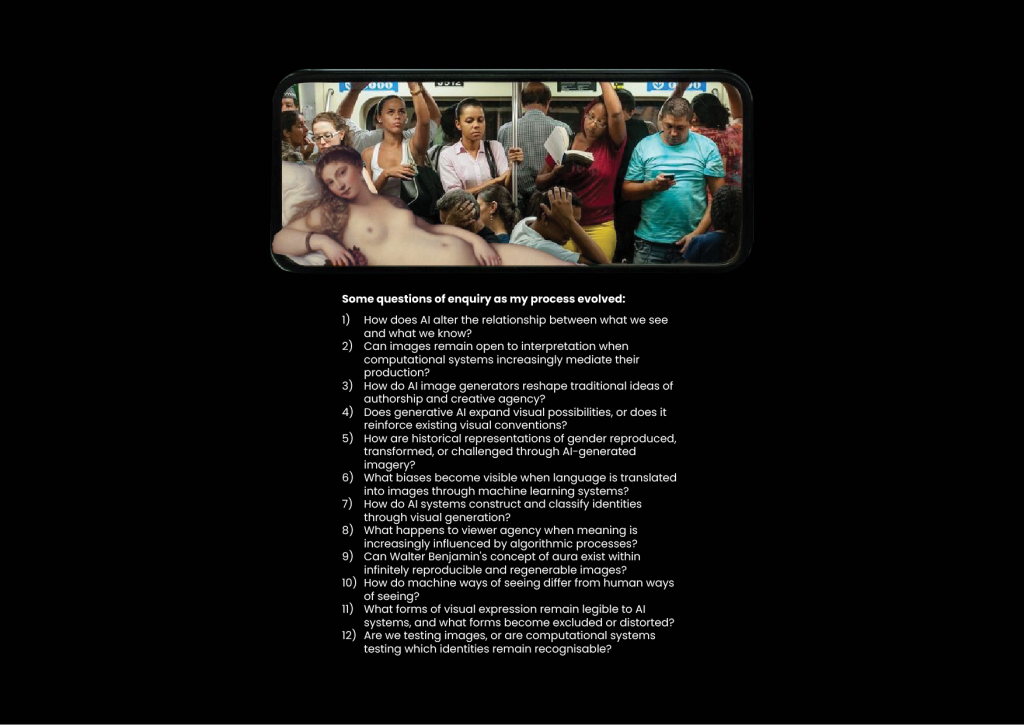
Some of the key questions that continue to shape my enquiry are:
How do AI systems reshape traditional ways of seeing?
What happens to viewer agency within AI-generated systems?
How do computational systems regulate visibility?
Can AI-generated variation truly create openness, or does it reinforce dominant visual patterns?
How are patriarchal biases reproduced through optimisation systems?
What happens to authorship when image-making becomes machine-mediated?
How do datasets and algorithms shape interpretation before the viewer even encounters the image?
How does AI shift the role of images from cultural interpretation toward machine-readable data?
How do images invite, resist, or complicate ways of seeing once they are generated through AI?
At its core, my project investigates how visibility is controlled, structured, and standardised through computational image generation, and how systems of AI reshape the relationship between seeing, interpretation, and power.
Citation: Berger, J. (1972) Ways of Seeing. London: Penguin.
Images are man-made and embody ways of seeing.
Annotation: Berger’s Ways of Seeing forms the conceptual foundation of my project, particularly his argument that images embody specific ways of seeing and that meaning is shaped through context, perception, and cultural frameworks rather than being inherent. His claim that “seeing comes before words” and that perception is never neutral informs my understanding of images as constructed rather than fixed. Rather than analysing these ideas theoretically, I treat them as a system to be tested through practice. In my iterative reworking of Venus of Urbino, I apply different “ways of seeing” through AI prompts, treating each iteration as a controlled variation in perception. This allows me to observe how meaning shifts across outputs, demonstrating that the image does not hold a singular meaning but is continuously reinterpreted through different conditions of viewing. Berger’s framework therefore moves from theory to method, shaping my process as a structured investigation into how systems of seeing construct meaning.
2. Design and Crime (And Other Diatribes)
Citation: Foster, H. (2002) Design and Crime (And Other Diatribes). London: Verso.
Digital mediation transforms objects into data, allowing them to be continuously reproduced, reformatted, and consumed.
Annotation: Foster’s discussion of digital mediation, where objects are transformed into data that can be endlessly reproduced and redesigned, directly informs my understanding of AI image-making as a system rather than a tool. His argument that design operates within continuous cycles of production and consumption parallels my iterative reworking of Venus of Urbino, where the image is repeatedly generated and altered through AI prompts. In this process, the image is no longer a fixed object, but a flow of variations shaped by computational systems. This shifts my approach away from producing a final image and towards using iteration as a method of enquiry. Foster’s framework allows me to critically position my work within these digital systems, recognising how meaning is not inherent, but constructed through processes of mediation, repetition, and transformation.
1 reference that is specifically related to my project in it’s theme
3. Bell hooks
Citation: hooks, b. (1996) Reel to Real: Race, Sex and Class at the Movies. (Referenced via: media-studies.com)
Representation is shaped by intersecting systems of race, gender, and class within what hooks calls the “white supremacist capitalist patriarchy.
Annotation: Bell hooks’ concept of intersectionality expands my understanding of images as sites where multiple systems of power intersect, particularly race, gender, and class. Her argument that media representations are not neutral but constructed within a “white supremacist capitalist patriarchy” challenges the idea of images as singular or objective. Instead, representation becomes a controlled system that shapes how identities are seen and understood. This directly informs my project, where I treat Venus of Urbino not as a fixed image, but as one embedded within historical and ideological systems of viewing. By iterating the image through different prompts, I begin to test how these systems shift meaning and representation. hooks’ framework pushes my enquiry beyond perception alone, introducing power as a critical layer in how images are constructed and interpreted. This allows me to recognise that systems of seeing are not neutral, but are shaped by broader cultural and political structures that influence how meaning is produced.
1 reference that demonstrates a critical position in context of your specific topic, medium, or method
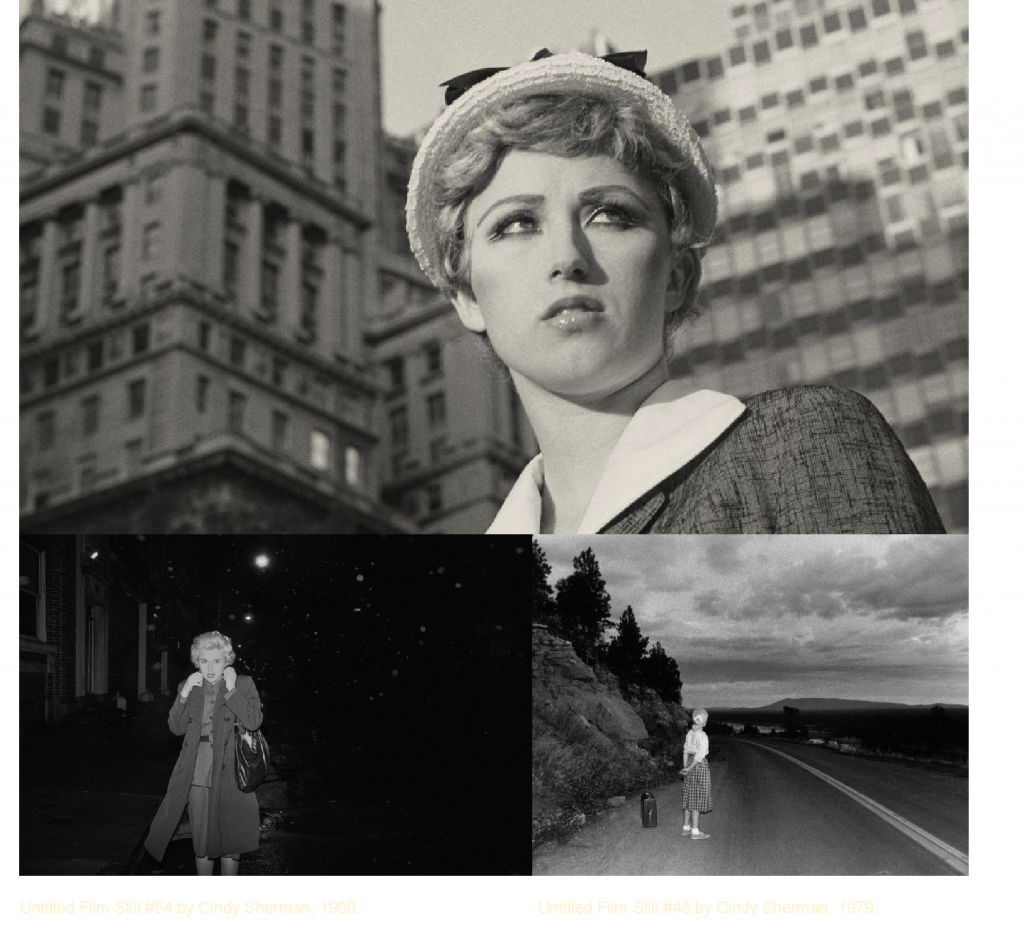
4. Cindy Sherman
Citation: Sherman, C. (1977–1980) Untitled Film Stills.
Sherman stages herself as multiple stereotypical female characters, revealing identity as constructed through repetition and visual codes.
Annotation: Sherman’s Untitled Film Stills reveal how identity within images is constructed through repetition, performance, and cultural coding rather than inherent truth. By repeatedly staging herself as different stereotypical female roles, she exposes how femininity is produced through systems of representation shaped by the gaze and broader ideological structures. This directly informs my iterative reworking of Venus of Urbino, where the image is subjected to multiple transformations through AI prompts. Like Sherman’s use of repetition, my process generates variations of a single image, each shaped by a different system of seeing. However, while Sherman performs within existing visual codes, I extend this through computational systems, where meaning is produced not only through cultural conventions but also through algorithmic interpretation. This enables me to test how identity, power, and meaning shift when the act of seeing is mediated and automated.
1 reference that demonstrates a critical position in context of my specific medium/ method
5. AI art: the end of creativity or a new movement?
Citation: Baxter, C. (2024) AI art: the end of creativity or a new movement? BBC Future.
AI challenges traditional ideas of creativity and authorship, positioning image-making as a collaboration between human input and machine systems.
Annotation: This article situates AI image-making within a broader debate around creativity, authorship, and artistic intention, which directly informs my use of AI as a method of iteration. My engagement with AI began from a position of ethical uncertainty, as I questioned whether it could be considered a legitimate tool within my practice. Rather than avoiding it, I chose to test it as a system—using prompts and iteration to explore how images are produced and interpreted through it. This shifted my focus away from outcomes and towards understanding AI as a system of seeing. The article reinforces this by presenting AI not as a neutral tool, but as an active participant in image production. However, I do not treat these outputs as resolved works, but as material for further intervention. My authorship therefore emerges through how I frame, manipulate, and rework these images, allowing me to test systems of seeing while retaining control over how meaning is constructed.
1 wild card reference (identifying the type of relationship of the above prompts)
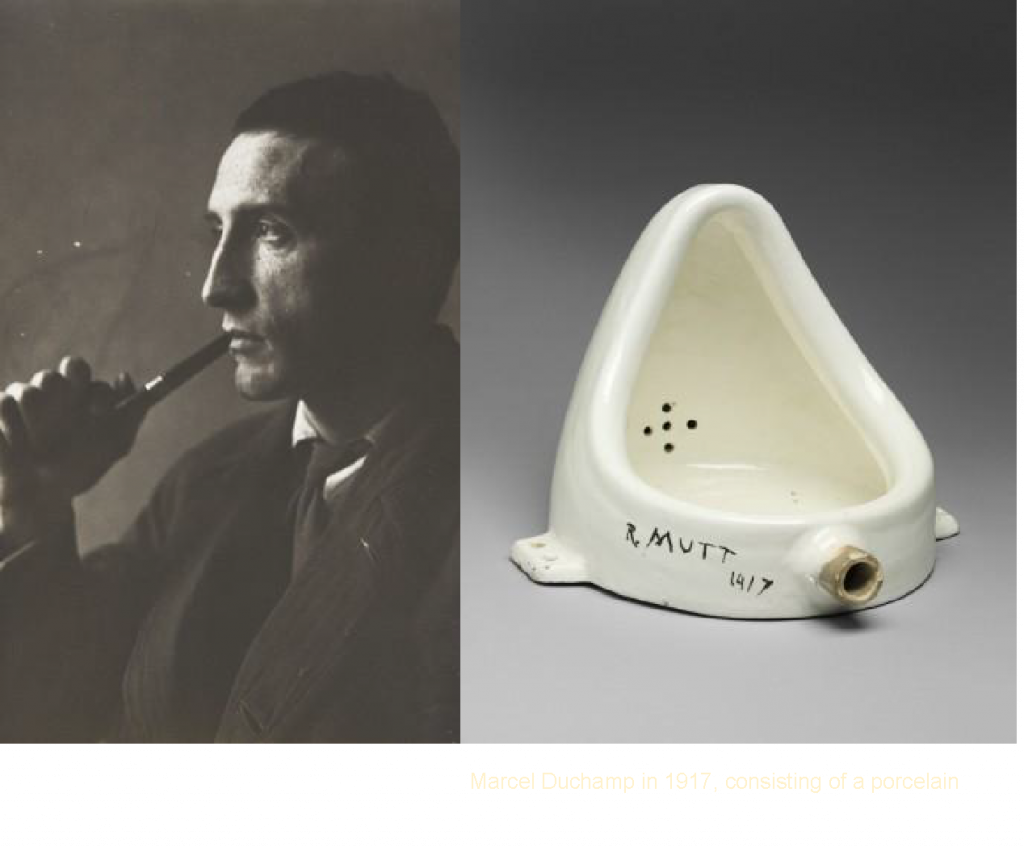
6. Marcel Duchamp
Citation: Philadelphia Museum of Art (2017) Marcel Duchamp and the Fountain Scandal.
A mass-produced urinal was submitted as art, shifting authorship from making to selection and context.
Annotation: Duchamp’s Fountain challenges traditional notions of artistic authorship by proposing that art can be defined through selection, positioning, and context rather than manual creation. By presenting a mass-produced object as art, he shifts the role of the artist from maker to decision-maker, foregrounding the importance of framing in constructing meaning. This informed my response to contemporary debates around AI, particularly through the BBC article, where similar tensions around creativity, authorship, and legitimacy emerge. It led me to question whether AI could be understood as a contemporary form of avant-garde practice, in the way it disrupts established ideas of image-making and artistic control. This felt like a deliberately controversial question within my own enquiry.
However, while Duchamp removes the need for making entirely, my process diverges from this position. I use AI to generate variations as a way of testing systems of seeing, but do not treat these outputs as resolved works. Instead, authorship is reintroduced through how I frame, manipulate, and rework these images. Duchamp therefore acts as a point of departure, allowing me to question authorship while ultimately repositioning it within my own process of intervention and construction.
This project investigates how meaning within images is constructed and transformed through different systems of seeing. Drawing from Berger’s Ways of Seeing, I approach perception not as neutral, but as shaped by cultural, ideological, and technological frameworks. Rather than analysing these ideas theoretically, I test them through an iterative process, using AI as a system to generate multiple variations of a single image (Venus of Urbino). Each iteration applies a different condition of viewing, allowing me to observe how meaning shifts across outputs.
My use of AI emerges from a position of ethical and conceptual uncertainty, leading me to treat it not as a tool for producing final images, but as a system for experimentation. The generated outputs are not considered resolved works, but material for further intervention. Through processes of framing, cutting, and manipulation, I reassert authorship and construct meaning. The project therefore explores how images are not fixed, but continuously reinterpreted through systems of seeing, while questioning how authorship operates within computational image-making.
This project unfolded in three stages: imitation, hacking and synthesis. Each stage involved a process of trial, confusion and reflection, gradually shifting my understanding of augmented reality as both a tool and a medium.
1.Imitation: learning the software through repetition
The first stage of the project began with imitation. I chose an existing AR project and attempted to recreate it as accurately as possible in order to understand how the software actually works. This stage involved an extensive amount of trial and error. I repeatedly rebuilt the project in order to match what I had seen in the original work, often restarting the process several times just to understand how different elements interacted.
Through this process I learned the fundamental mechanics of the software: how assets are stacked in depth, how animation timing works, how sound can be synchronised with visual triggers, and how 2D and 3D elements coexist within the same spatial environment. What initially appeared simple was in fact very elaborate and time-consuming. Many adjustments required careful micro-tuning, and small changes often affected the entire sequence.
Although frustrating at times, this stage was extremely valuable because it created a framework for understanding how AR operates technically. By reconstructing the work piece by piece, I began to see how layering, timing and spatial relationships shape the experience. This stage ultimately set a precedent for how I would approach AR throughout the rest of the project.
2. Emotional Leakage: attempting to hack the system
The second stage asked us to move beyond imitation and begin hacking the tool, using the software in a way that subverts its intended purpose. I initially approached this by exploring AR as a navigational system that gradually breaks down. Because AR is often used for guidance and wayfinding, I thought it would be interesting to create a system that begins as a functional navigation tool but slowly deteriorates.
This experiment evolved into what I described as emotional leakage. The interface moved through stages such as minimal fracture, irritation, judgement, hesitation and eventual withdrawal of clarity, leading to a collapse of the system. The idea was that the tool itself would begin to reveal emotional instability through its behaviour.
However, when presenting this stage during Progression 2, I realised I was not fully satisfied with the result. Although the idea sounded interesting conceptually, it did not feel like a successful “hack.” Instead, it felt as though I was forcing an emotional narrative onto the tool rather than truly interrogating the medium. This created a mental block in my process because the work no longer felt aligned with the intention of the assignment.
I discussed these difficulties with my tutor, who suggested exploring other directions such as censorship or narrative control, ways in which AR could potentially intervene in how images or information are presented. While these ideas were helpful, the project still felt unresolved. Stage two left me feeling confused rather than confident about where the work should go next.
3. Final synthesis: returning to the medium
Moving into the final stage, I found myself reflecting on the earlier parts of the project, particularly the imitation phase. After stepping back and reviewing my experiments, I began to realise that some of the most interesting discoveries had already occurred during those early technical explorations. Techniques such as depth stacking and spatial layering had repeatedly appeared throughout my tests, and they seemed to offer a clearer connection between the medium and the concept.
Through conversations with my professor, I started to reconsider how these technical discoveries could inform the final outcome. Instead of trying to construct a complex narrative system or multiple AR interactions, I decided to focus on a single trigger image and explore how layering itself could become the central mechanism of the work.
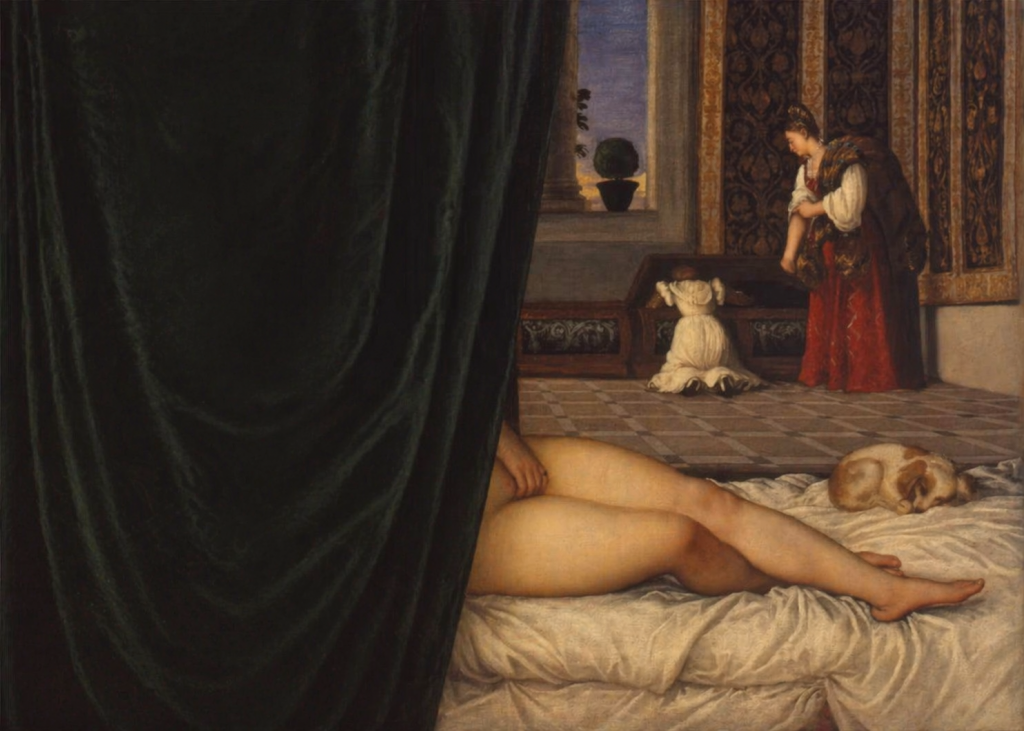
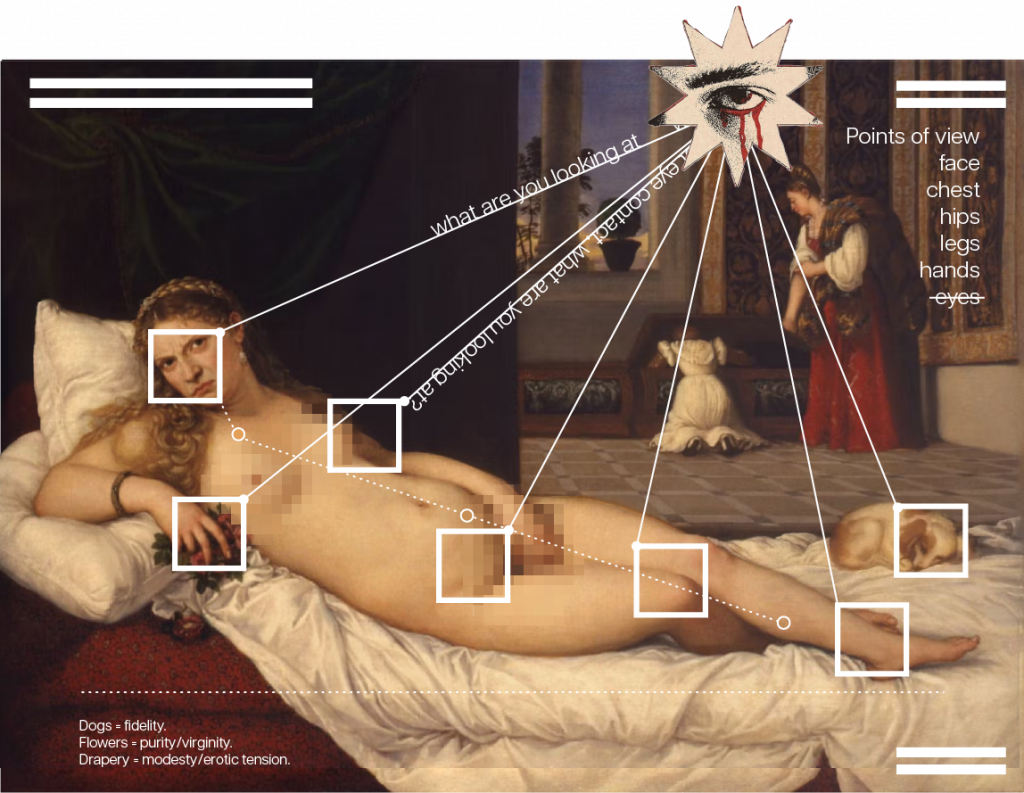
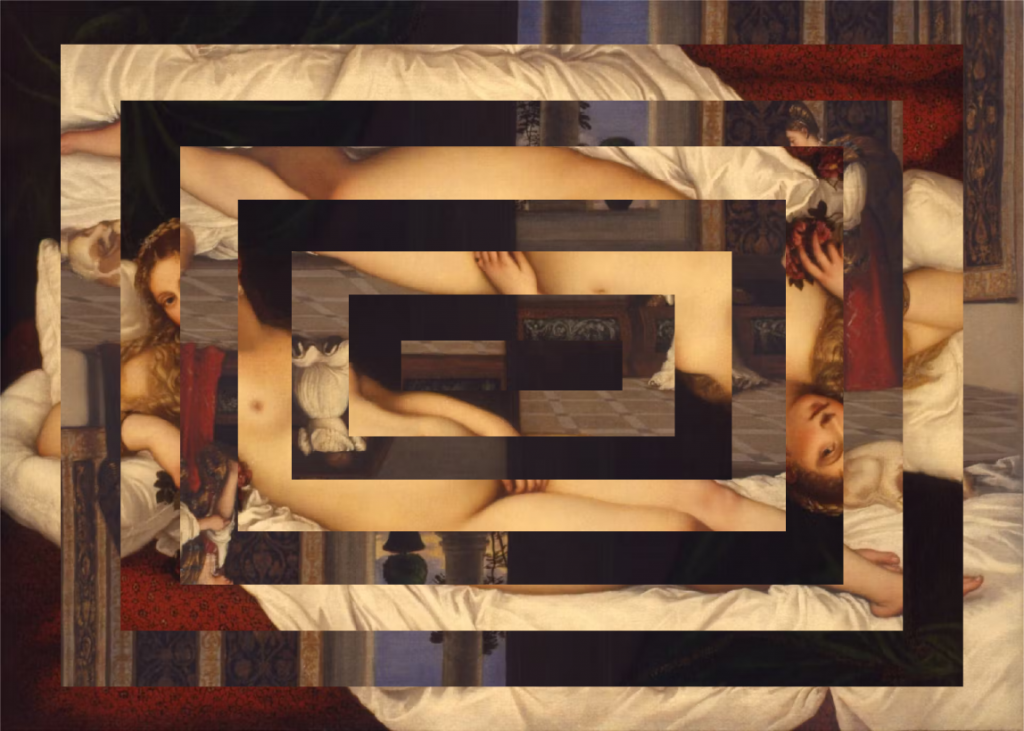
This shift eventually led me to the idea of examining the male gaze within a historical painting. Rather than altering the painting directly, I used AR to fragment the image into spatial layers that only align when viewed from a particular perspective. As the viewer moves around the work, hidden elements appear behind the surface—cropped fragments, gaze markers and symbolic references that point toward the historical construction of the female body in art.
By requiring the viewer to physically move in order to reconstruct the image, the work transforms the act of looking into an active process. In this way, the final project emerges directly from the lessons learned throughout the earlier stages: experimentation with the tool, failed attempts at hacking it, and a return to the medium’s own technical possibilities as a way of generating meaning.
Reflection
Looking back, the most valuable part of this project was the process of learning through uncertainty. The assignment required not only experimentation with a new tool, but also a willingness to question and revise my own assumptions about how ideas should be developed. Several stages of the project did not work in the way I expected, and moments of technical difficulty or conceptual confusion often slowed the process down. However, these moments ultimately became productive because they forced me to return to the medium itself and reconsider what it was capable of communicating. By moving between imitation, hacking and reflection, I began to understand AR not simply as a platform for displaying content but as a system that shapes how images can be experienced. This process of learning and unlearning made the final outcome feel less like a fixed solution and more like the result of an ongoing inquiry into how tools influence the way we design, interpret and see.
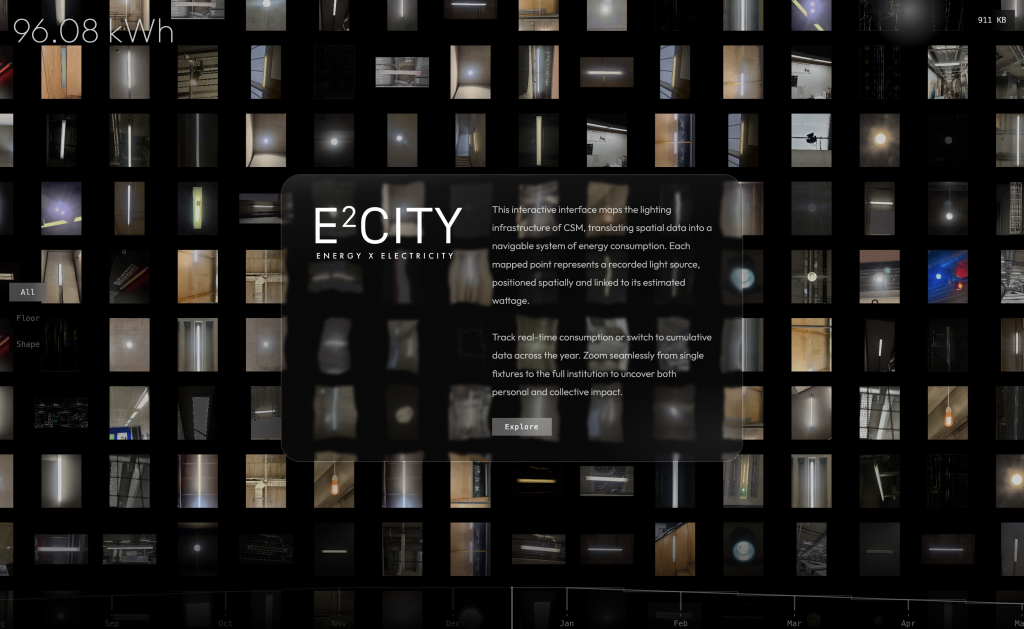
Our enquiry asked: How can electricity consumption at CSM be visualised across temporal scales? In dialogue with UAL’s Net Zero and Sustainability Implementation Plan (NZSIP), we focused on lighting as a measurable yet infrastructural form of consumption, where institutional decisions shape collective environmental impact.
Following preliminary research and user testing, we conducted primary data collection across all four floors of the CSM building, documenting light fixtures through systematic photography and spatial mapping. We catalogued fixtures, researched bulb types, and estimated wattage through conversations with facilities staff, producing close approximations of overall consumption. While access restrictions limited exact measurements, the process revealed something unexpected: the overwhelming density of light sources. What appeared mundane became a vast system of diffuse energy expenditure.
Our challenge was not simply to visualise data, but to do so responsibly. We were conscious of two risks: drowning the viewer in excessive information, or flattening complexity through oversimplification. To navigate this tension, we used mapping, cataloguing, and grid structures combined with compression and expansion of scale. The interactive website allows users to zoom between macro and micro perspectives. Zooming out reveals cumulative institutional load; zooming in isolates a single fixture, displaying its location, wattage, and estimated consumption. A dynamic total usage counter and seasonal time scale layer temporal context without overwhelming the interface.
By structuring access rather than presenting everything at once, we treated visualisation as interpretation, positioning graphic design as a mediator between infrastructural systems, institutional accountability, and public understanding.
Draft 1
Accountability in Practice
Working on this project shifted my understanding of graphic design as a relational practice. Rather than treating energy consumption as neutral data to be visualised, I became aware of how design actively reconfigures the contexts it operates within, environmental, institutional, and social.
Engaging with UAL’s Net Zero and Sustainability Implementation Plan (NZSIP) initially felt abstract. Targets, percentages, and long-term ambitions existed at a scale that felt distant from everyday practice. However, conducting on-site documentation across the CSM building—photographing, mapping, and cataloguing hundreds of light fixtures—brought those ambitions into material focus. Climate responsibility became spatial and immediate. Each bulb represented a small, seemingly insignificant decision, yet collectively formed an infrastructural system of considerable environmental weight.
This process reshaped my position as a practitioner. I became more conscious that design does not simply reflect institutional strategies; it mediates how they are understood and felt. Constructing the interface required negotiating between accessibility and complexity, resisting both spectacle and oversimplification. I realised that visualisation is never neutral, it structures perception, distributes attention, and subtly frames accountability.
Working across scales, from a single fixture to cumulative institutional load, from daily rhythms to seasonal patterns, deepened my awareness of how climate justice operates through accumulation. For me, this project clarified that responsible graphic communication is not about producing definitive answers, but about making systems legible while acknowledging their limits. It reinforced my commitment to practice as situated, iterative, and critically attentive to the contexts it inevitably reshapes.
Draft 2
Annotated Bibliography: Six References Informing “From Bulb to Building”
2 texts from the reading list:
Steyerl, H. (2012) ‘In Defense of the Poor Image’, in The Wretched of the Screen. Berlin: Sternberg Press.
Steyerl’s notion of the “poor image” reshaped how we thought about visibility, circulation, and value within our project. Although our focus was electricity consumption rather than image compression, Steyerl’s argument that images gain political force through distribution rather than resolution helped us reconsider fidelity. Our lighting data was incomplete due to institutional restrictions and estimation limits. Instead of perceiving this as a weakness, Steyerl’s framing allowed us to see approximation as structurally embedded within systems of access and power. The project thus became less about producing a perfect dataset and more about exposing infrastructural conditions that shape what can be seen and measured. The website interface, which layers information progressively, mirrors the idea that visibility is constructed and mediated. Steyerl’s writing deepened our awareness that transparency is never total, and that representing institutional systems involves negotiating gaps, compressions, and constraints.
Reinfurt, D. (2019) I-N-T-E-R-F-A-C-E: A New Program for Graphic Design. Los Angeles: Inventory Press.
Reinfurt’s conception of interface as an active structure rather than a neutral surface strongly influenced our approach to the website. He frames graphic design as programmatic—organising how information is accessed and sequenced. This resonated with our need to mediate between micro and macro scales of energy consumption. Instead of presenting all lighting data simultaneously, we structured access through zoom functionality and temporal sliders, allowing scale to become navigable rather than fixed. Reinfurt’s pedagogical emphasis on systems thinking reinforced our grid-based mapping strategy and iterative testing process. His work helped position the interface itself as a site of contextualisation: the way information is arranged shapes how responsibility and accountability are perceived. This shifted our understanding of design from representational to relational—where interaction produces meaning.
Garland’s manifesto, and its continued revision, foregrounds design’s ethical responsibility within social and environmental contexts. Engaging with this text positioned our project within a lineage of designers questioning where attention and labour should be directed. By focusing on institutional energy infrastructure rather than aesthetic spectacle, our project aligns with the manifesto’s call to prioritise socially consequential communication. The updated discussions around sustainability and climate justice reframed our enquiry as more than a formal exploration of scale; it became a reflection on how graphic communication can redirect institutional focus toward environmental accountability. Garland’s insistence that design is never neutral strengthened our awareness that visualising energy data is itself a political act—shaping what is prioritised, questioned, or ignored.
Latour, B. (2004) ‘Why Has Critique Run out of Steam? From Matters of Fact to Matters of Concern’, Critical Inquiry, 30(2), pp. 225–248.
Latour’s distinction between “matters of fact” and “matters of concern” informed how we approached energy data. Rather than presenting electricity consumption as detached numerical fact, we aimed to frame it as a shared concern embedded within institutional systems. Latour’s argument that critique should assemble rather than merely debunk resonated with our method of mapping and layering rather than exposing failure. The project does not accuse; instead, it situates viewers within a network of infrastructural relations. By allowing users to navigate between individual fixtures and cumulative load, the interface assembles connections between small-scale actions and systemic impact. Latour’s framework strengthened our understanding of contextualisation as relational: energy consumption becomes meaningful not in isolation, but within networks of policy, architecture, and daily use.
Worth’s project provided a crucial precedent for working with extreme shifts in scale. By translating astronomical distances into scrollable digital space, he makes incomprehensible magnitude experientially navigable. This approach directly informed our zoom-based interface, where users transition from individual light fixtures to institutional accumulation. Worth’s work demonstrates how digital interaction can convert abstract data into embodied spatial experience. Rather than compressing scale into a static infographic, he expands it temporally and spatially, allowing users to feel distance through duration. This strategy influenced our decision to incorporate temporal sliders and cumulative counters, reinforcing the experiential dimension of energy consumption. Worth’s project showed that scale can be designed as an interface condition, not merely represented visually.
Eliasson’s practice foregrounds perception, uncertainty, and environmental awareness through spatial installation. Uncertain informed our sensitivity to how viewers encounter systems rather than simply observe them. Eliasson often makes invisible forces—light, atmosphere, climate—materially perceptible without reducing their complexity. This resonated with our attempt to visualise infrastructural lighting systems without flattening nuance. His work emphasises relational experience: meaning emerges through interaction between body, space, and environment. While our medium was digital rather than architectural, the principle remains similar. By structuring zoom and temporal navigation, we aimed to produce awareness through movement rather than didactic explanation. Eliasson’s approach reinforced our understanding that climate-oriented design should cultivate attentiveness rather than overwhelm, balancing clarity with openness.
Draft 1 Methods of Iteration: Copying an AR Project
For this project I chose to work with Augmented Reality, a medium I had no prior experience with and one I had found intimidating because of its perceived technical and temporal demands. Although I had been curious about AR for some time, it had always seemed monumental and inaccessible within the constraints of other deadlines. This brief offered an opportunity to confront that hesitation by copying an existing AR project using KiwiCube, a platform marketed as an accessible entry point into the field.
The process immediately proved more layered and time-intensive than expected. Each illustrated element had to be produced separately, uploaded, positioned within an augmented spatial environment, distributed across multiple depths, and animated individually. Animation was particularly destabilising: small changes in axis points, angles, or timing produced disproportionately large effects. Progress took continuous cycles of trial and error watching tutorials, dissecting pre-existing templates, borrowing animation behaviours, and repeatedly testing how these translated to my own imagery.
Because much of my past work sits within food, beverage, and children’s toy packaging, I approached this project with a desire to create playful, future-facing experiences that bring a sense of magic into everyday digital encounters. This raised questions about how AR can extend surface-level graphics into spatial moments of delight, how much complexity sits behind these effects, and whether such systems genuinely open access to wonder or quietly restrict who gets to make and experience them.
Draft 2 While developing my Stage 2 AR project, I kept returning to the same question: was I producing multiple outcomes, or was I genuinely iterating? I was duplicating the same KiwiCube file, fixing the navigational grammar, and escalating tone and visual noise across different locations, but I had not yet articulated what kind of knowledge this process was generating.
Reading Conditional Design Workbook reframed this uncertainty. Andrew Blauvelt, Luna Maurer, Edo Paulus, Jonathan Puckey and Roel Wouters describe design not as the execution of a preconceived message, but as the construction of systems whose rules generate form (Blauvelt et al., 2013). Instead of expression first, they foreground constraints, procedures and repetition as the site where meaning emerges. Seen through this lens, my AR project becomes less about narrative and more about behaviour.
The work takes the language of campus wayfinding, arrows, neutral typography, QR codes, institutional phrasing, and distributes it across studios, corridors and exits. The physical triggers remain calm and administrative, but once scanned the AR layer begins to fracture: directions become partial, side-notes interrupt instructions, and visual clutter increases. Viewers can enter the system at any point, encountering either a polite interface or one already mid-collapse.
Conditional Design helps me understand this as a rule-based structure rather than six separate artworks. I fixed the navigational framework and allowed only three variables to change: tone, density and clarity. Each iteration is a minor mutation inside the same system. Authority is not declared outright; it is produced through consistency and slowly destabilised through deviation.
What became clearer through the reading is how strongly systems shape both designers and users. Repeating the same instructions forces me into a procedural role, part author, part operator, maintaining a service that is gradually failing. Meanwhile, participants are not spectators but test-cases inside a process, generating outcomes simply by following, doubting or abandoning the interface.
This has sharpened my enquiry. Rather than asking whether AR can become confrontational, I am asking how neutrality becomes persuasive in the first place. At what point does repetition turn into pressure? When does guidance slip into judgement? How much instability can an interface show before its authority collapses?
Conditional Design also made me attentive to what remains unchanged. The recognisable arrows and frames are crucial: without stability, breakdown would read as chaos rather than failure. Withholding information becomes a formal strategy rather than a narrative flourish. The interface keeps speaking, keeps occupying space, keeps performing service, while quietly refusing to complete the task it promised.
Using this text as a lens allows me to frame the project as a procedural experiment embedded in architecture. The department becomes a testing ground; each trigger image another condition; each escalation a small adjustment to the rules. In that sense, misusing AR is not a gimmick but a method, a way of letting structure, rather than intention, expose how authority and dependence are constructed through design.
Reference Blauvelt, A., Maurer, L., Paulus, E., Puckey, J. and Wouters, R. (2013) Conditional Design Workbook. Amsterdam: Valiz.
Walking into St Pancras’ garden, I was struck by it’s quiet presence – a shortcut layered with unnoticed histories. This research explores how memory, design and time converge in this space. Through walking, photographing and reflecting I examined how human intention and natural growth shape remembrance. My process draws on Janet Cardiff’s the missing voice (case study B)(1999) and George Perec’s Species of Spaces and other Pieces (1974), both of which explore how perception transforms experience.
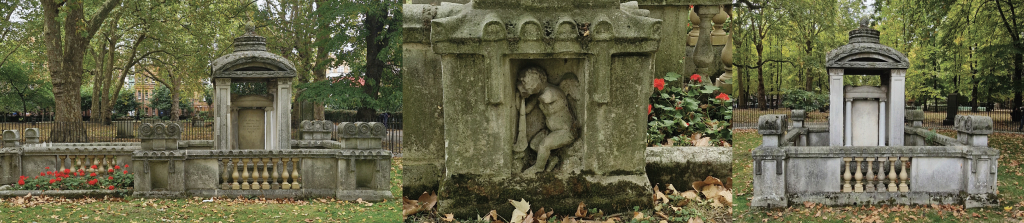
The Soane Tomb first drew my attention. Its canopy-like structure, flanked by cherubs on one side, suggested an intimate act of devotion expressed through architecture. Its later influence on London’s red telephone booth extended this personal gesture into collective memory. Perec’s idea that “the street, the neighbourhood, the city are accumulations of the lived, the observed, the remembered”(Peres, 1974, p. 91) becomes visible here: private love reshaping public form, grief turning into shared design.
The Burdett-Coutts Memorial Sundial revealed another dimension of memory. Guarded by lions and dogs and decorated with mosaic, it’s layers of pattern and inscription demanded time and attention. The more I circled the monument, the more I found – each encounter uncovering care and purpose.
Cardiff (1999) writes that her sound walks depend on listener’s physical movement to “activate the narrative”. Likewise, walking around the sundial transformed passive viewing into participation, memory unfolded through motion.
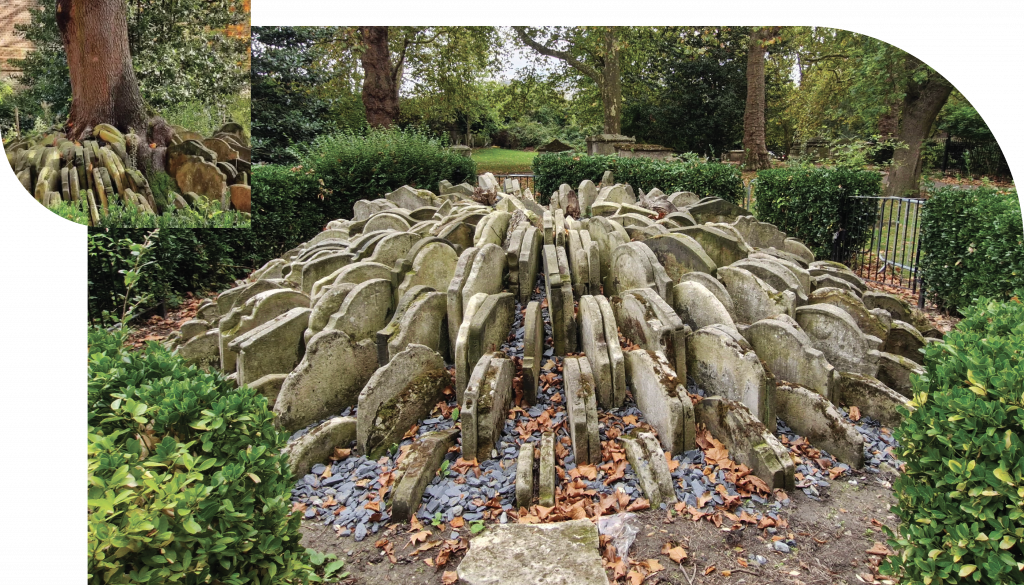
At the site of The Hardy Tree, absence itself carried meaning. The original tree, lost to disease in 2022, had once gathered gravestones relocated by a young Thomas Hardy. What began as an act of order became a natural sculpture – human planning overtaken by growth. Perec’s claim that “what we call ordinary is what we fail to observe”(Perec, 1974, p. 50) resonates here: the mound’s quiet persistence shows how memory continues through observation rather than monumentality.
Alongside these explorations and observations, I created a publication of my research and findings designed to guide visitors through the garden and prompt reflection, turning the act of walking into an exploration of memory and presence. I also conducted an online survey to collect the silent questions that might linger rather than answer:
What role does memory play in how we experience a place? Do we live on through what we create or through how we are remembered? Can love expressed through memorials endure decay? These emerged from my time in the garden, especially the Hardy Tree, where memory felt active – non static – shaped by weather, growth and time.
Critically this process deepened my understanding of observation as an act of creation. Through Cardiff, I learnt that presence completes the work: through Perec, that attention transforms spaces.
St Pancras Garden became a dialogue between presence and absence, where memory is relational and continually rewritten. For future studio practice, this encourages methods rooted in reflection and participation – creating experiences where spaces, like memories speak through those who choose to look.
References
Cardiff, J. (1999) The Missing Voice (Case Study B). London: Artangel.
Perec, G. (1974) Species of Spaces and Other Pieces. London: Penguin, 1997.