This project unfolded in three stages: imitation, hacking and synthesis. Each stage involved a process of trial, confusion and reflection, gradually shifting my understanding of augmented reality as both a tool and a medium.
1.Imitation: learning the software through repetition
The first stage of the project began with imitation. I chose an existing AR project and attempted to recreate it as accurately as possible in order to understand how the software actually works. This stage involved an extensive amount of trial and error. I repeatedly rebuilt the project in order to match what I had seen in the original work, often restarting the process several times just to understand how different elements interacted.
Through this process I learned the fundamental mechanics of the software: how assets are stacked in depth, how animation timing works, how sound can be synchronised with visual triggers, and how 2D and 3D elements coexist within the same spatial environment. What initially appeared simple was in fact very elaborate and time-consuming. Many adjustments required careful micro-tuning, and small changes often affected the entire sequence.
Although frustrating at times, this stage was extremely valuable because it created a framework for understanding how AR operates technically. By reconstructing the work piece by piece, I began to see how layering, timing and spatial relationships shape the experience. This stage ultimately set a precedent for how I would approach AR throughout the rest of the project.


2. Emotional Leakage: attempting to hack the system
The second stage asked us to move beyond imitation and begin hacking the tool, using the software in a way that subverts its intended purpose. I initially approached this by exploring AR as a navigational system that gradually breaks down. Because AR is often used for guidance and wayfinding, I thought it would be interesting to create a system that begins as a functional navigation tool but slowly deteriorates.
This experiment evolved into what I described as emotional leakage. The interface moved through stages such as minimal fracture, irritation, judgement, hesitation and eventual withdrawal of clarity, leading to a collapse of the system. The idea was that the tool itself would begin to reveal emotional instability through its behaviour.
However, when presenting this stage during Progression 2, I realised I was not fully satisfied with the result. Although the idea sounded interesting conceptually, it did not feel like a successful “hack.” Instead, it felt as though I was forcing an emotional narrative onto the tool rather than truly interrogating the medium. This created a mental block in my process because the work no longer felt aligned with the intention of the assignment.
I discussed these difficulties with my tutor, who suggested exploring other directions such as censorship or narrative control, ways in which AR could potentially intervene in how images or information are presented. While these ideas were helpful, the project still felt unresolved. Stage two left me feeling confused rather than confident about where the work should go next.
3. Final synthesis: returning to the medium
Moving into the final stage, I found myself reflecting on the earlier parts of the project, particularly the imitation phase. After stepping back and reviewing my experiments, I began to realise that some of the most interesting discoveries had already occurred during those early technical explorations. Techniques such as depth stacking and spatial layering had repeatedly appeared throughout my tests, and they seemed to offer a clearer connection between the medium and the concept.
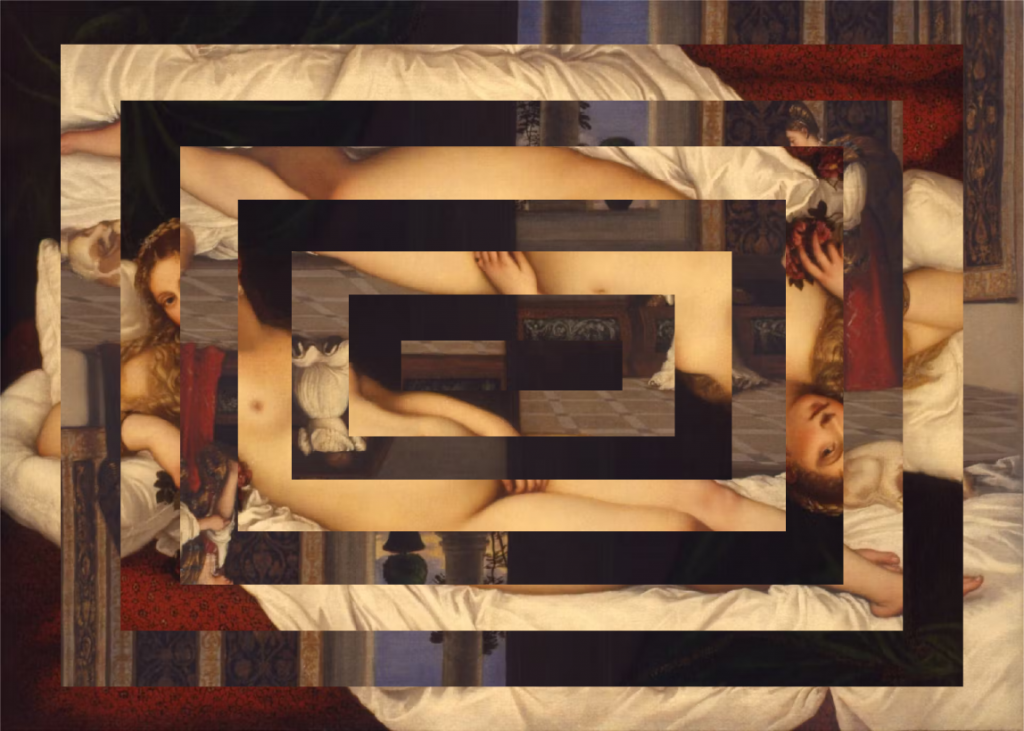
Through conversations with my professor, I started to reconsider how these technical discoveries could inform the final outcome. Instead of trying to construct a complex narrative system or multiple AR interactions, I decided to focus on a single trigger image and explore how layering itself could become the central mechanism of the work.
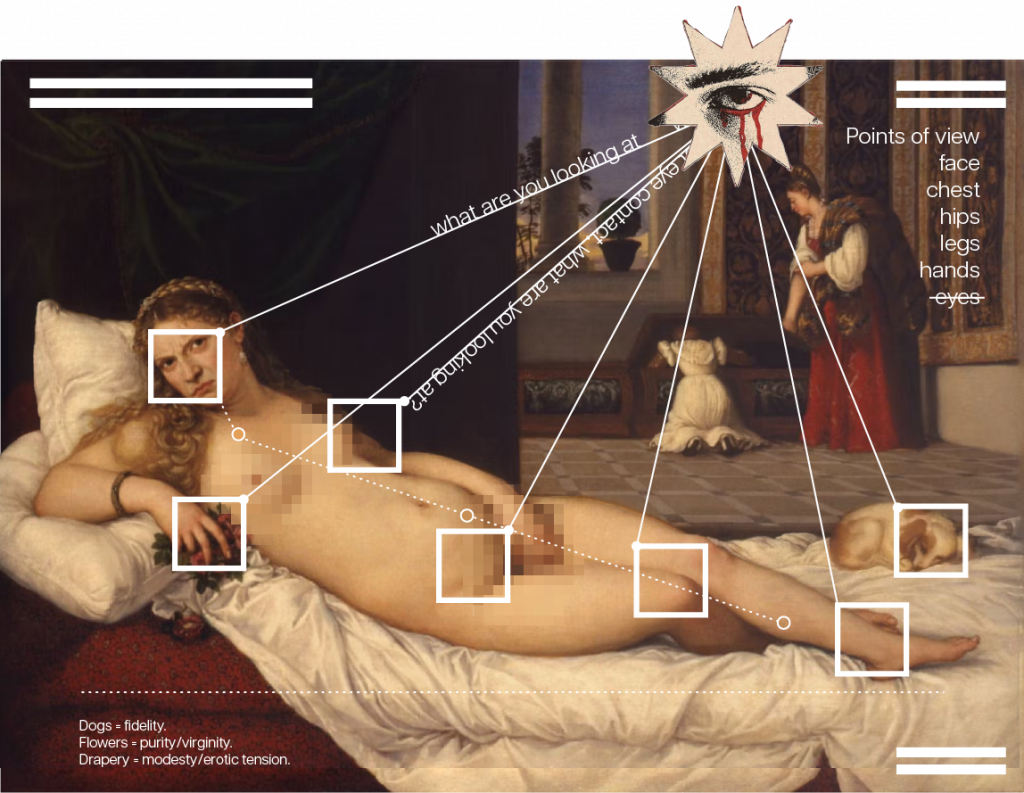
This shift eventually led me to the idea of examining the male gaze within a historical painting. Rather than altering the painting directly, I used AR to fragment the image into spatial layers that only align when viewed from a particular perspective. As the viewer moves around the work, hidden elements appear behind the surface—cropped fragments, gaze markers and symbolic references that point toward the historical construction of the female body in art.
By requiring the viewer to physically move in order to reconstruct the image, the work transforms the act of looking into an active process. In this way, the final project emerges directly from the lessons learned throughout the earlier stages: experimentation with the tool, failed attempts at hacking it, and a return to the medium’s own technical possibilities as a way of generating meaning.

Reflection
Looking back, the most valuable part of this project was the process of learning through uncertainty. The assignment required not only experimentation with a new tool, but also a willingness to question and revise my own assumptions about how ideas should be developed. Several stages of the project did not work in the way I expected, and moments of technical difficulty or conceptual confusion often slowed the process down. However, these moments ultimately became productive because they forced me to return to the medium itself and reconsider what it was capable of communicating. By moving between imitation, hacking and reflection, I began to understand AR not simply as a platform for displaying content but as a system that shapes how images can be experienced. This process of learning and unlearning made the final outcome feel less like a fixed solution and more like the result of an ongoing inquiry into how tools influence the way we design, interpret and see.
Leave a Reply