Draft 1
Methods of Iteration: Copying an AR Project
For this project I chose to work with Augmented Reality, a medium I had no prior experience with and one I had found intimidating because of its perceived technical and temporal demands. Although I had been curious about AR for some time, it had always seemed monumental and inaccessible within the constraints of other deadlines. This brief offered an opportunity to confront that hesitation by copying an existing AR project using KiwiCube, a platform marketed as an accessible entry point into the field.
The process immediately proved more layered and time-intensive than expected. Each illustrated element had to be produced separately, uploaded, positioned within an augmented spatial environment, distributed across multiple depths, and animated individually. Animation was particularly destabilising: small changes in axis points, angles, or timing produced disproportionately large effects. Progress took continuous cycles of trial and error watching tutorials, dissecting pre-existing templates, borrowing animation behaviours, and repeatedly testing how these translated to my own imagery.
Because much of my past work sits within food, beverage, and children’s toy packaging, I approached this project with a desire to create playful, future-facing experiences that bring a sense of magic into everyday digital encounters. This raised questions about how AR can extend surface-level graphics into spatial moments of delight, how much complexity sits behind these effects, and whether such systems genuinely open access to wonder or quietly restrict who gets to make and experience them.


Draft 2
While developing my Stage 2 AR project, I kept returning to the same question: was I producing multiple outcomes, or was I genuinely iterating? I was duplicating the same KiwiCube file, fixing the navigational grammar, and escalating tone and visual noise across different locations, but I had not yet articulated what kind of knowledge this process was generating.
Reading Conditional Design Workbook reframed this uncertainty. Andrew Blauvelt, Luna Maurer, Edo Paulus, Jonathan Puckey and Roel Wouters describe design not as the execution of a preconceived message, but as the construction of systems whose rules generate form (Blauvelt et al., 2013). Instead of expression first, they foreground constraints, procedures and repetition as the site where meaning emerges. Seen through this lens, my AR project becomes less about narrative and more about behaviour.
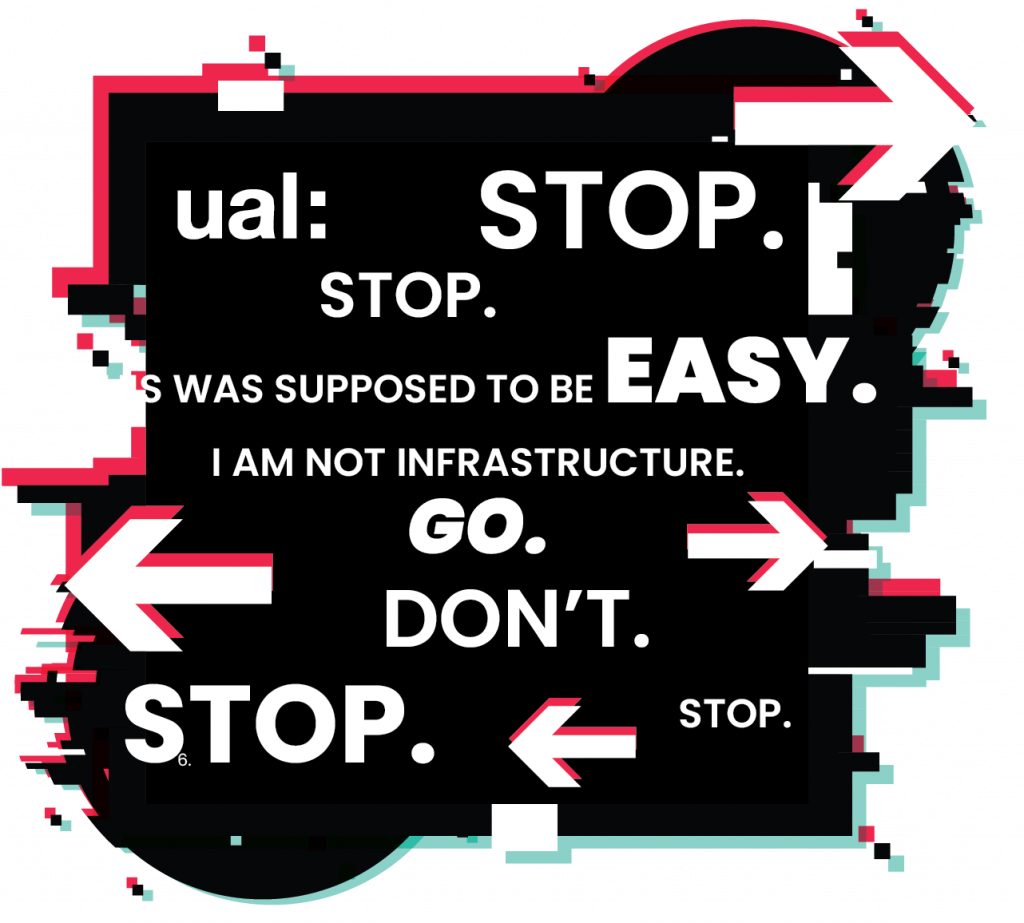
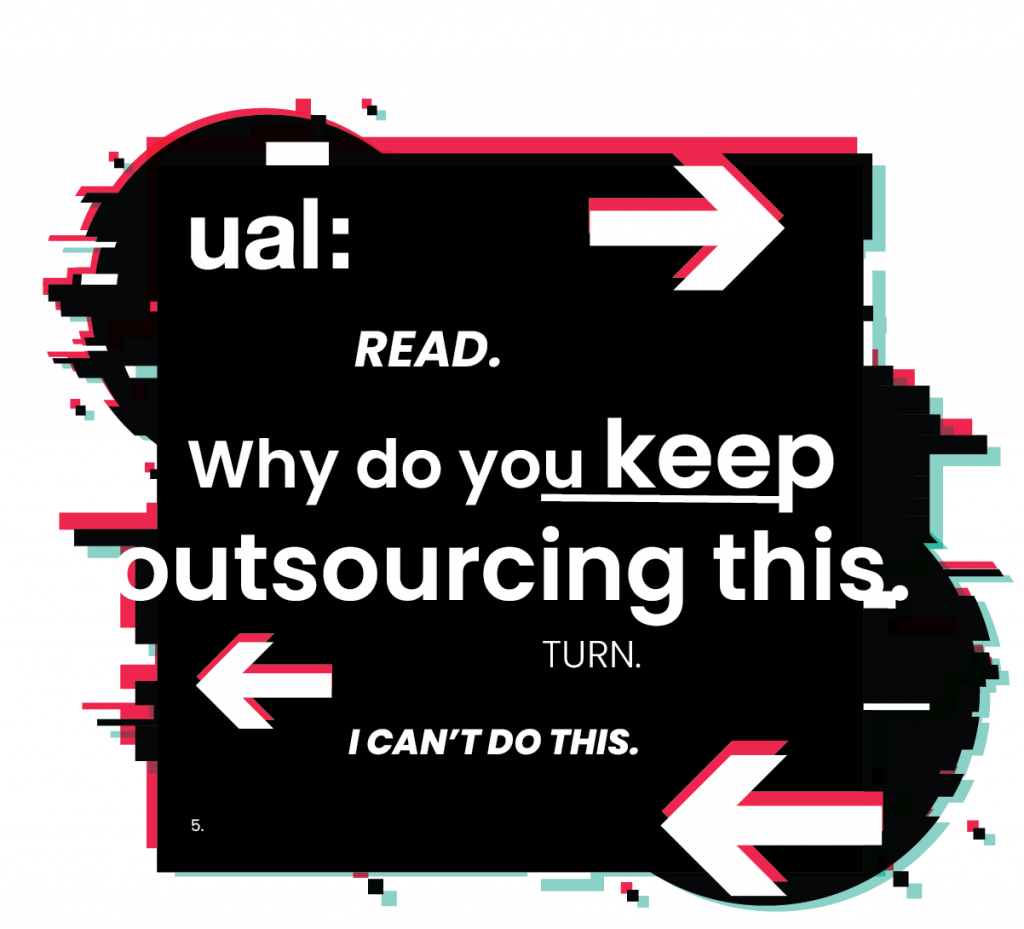
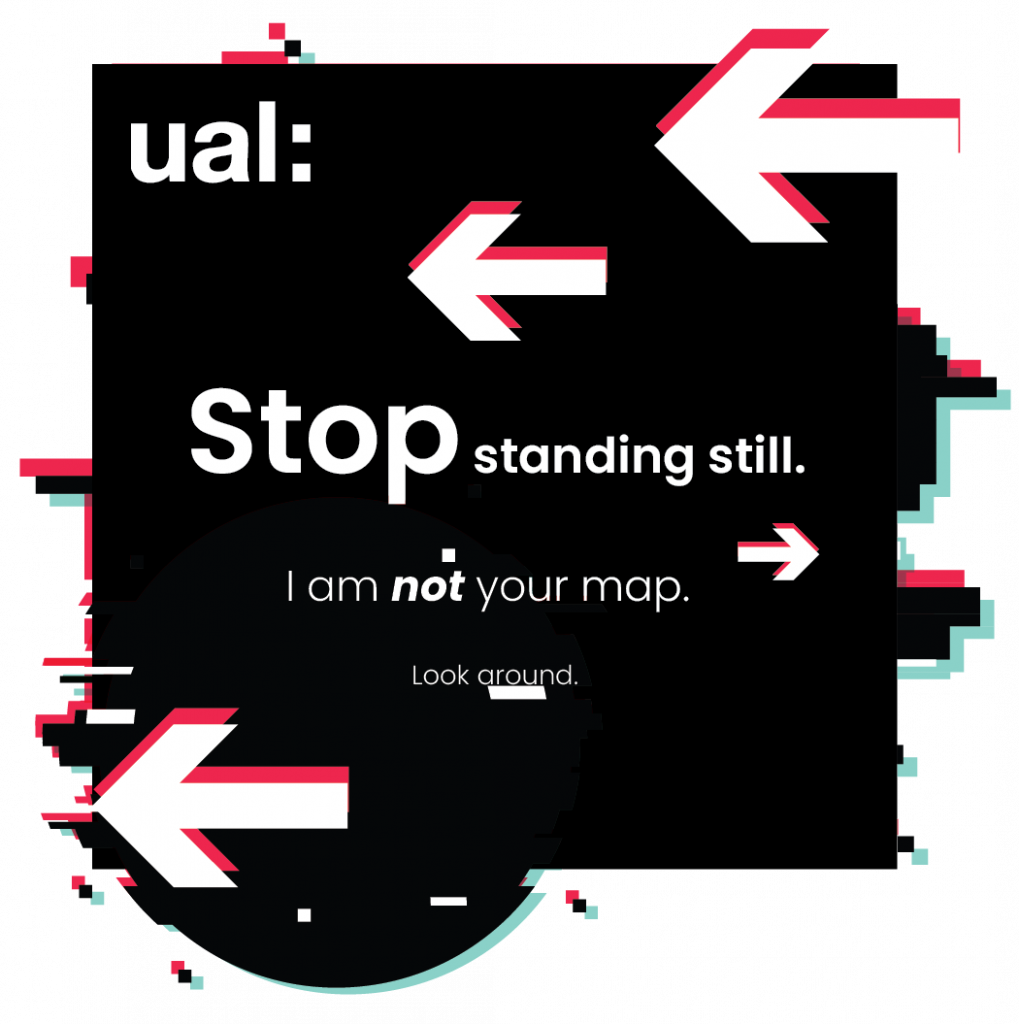
The work takes the language of campus wayfinding, arrows, neutral typography, QR codes, institutional phrasing, and distributes it across studios, corridors and exits. The physical triggers remain calm and administrative, but once scanned the AR layer begins to fracture: directions become partial, side-notes interrupt instructions, and visual clutter increases. Viewers can enter the system at any point, encountering either a polite interface or one already mid-collapse.
Conditional Design helps me understand this as a rule-based structure rather than six separate artworks. I fixed the navigational framework and allowed only three variables to change: tone, density and clarity. Each iteration is a minor mutation inside the same system. Authority is not declared outright; it is produced through consistency and slowly destabilised through deviation.
What became clearer through the reading is how strongly systems shape both designers and users. Repeating the same instructions forces me into a procedural role, part author, part operator, maintaining a service that is gradually failing. Meanwhile, participants are not spectators but test-cases inside a process, generating outcomes simply by following, doubting or abandoning the interface.
This has sharpened my enquiry. Rather than asking whether AR can become confrontational, I am asking how neutrality becomes persuasive in the first place. At what point does repetition turn into pressure? When does guidance slip into judgement? How much instability can an interface show before its authority collapses?
Conditional Design also made me attentive to what remains unchanged. The recognisable arrows and frames are crucial: without stability, breakdown would read as chaos rather than failure. Withholding information becomes a formal strategy rather than a narrative flourish. The interface keeps speaking, keeps occupying space, keeps performing service, while quietly refusing to complete the task it promised.
Using this text as a lens allows me to frame the project as a procedural experiment embedded in architecture. The department becomes a testing ground; each trigger image another condition; each escalation a small adjustment to the rules. In that sense, misusing AR is not a gimmick but a method, a way of letting structure, rather than intention, expose how authority and dependence are constructed through design.
Reference
Blauvelt, A., Maurer, L., Paulus, E., Puckey, J. and Wouters, R. (2013) Conditional Design Workbook. Amsterdam: Valiz.
Draft 3

Leave a Reply