
Methods Of Investigating
Walking into St Pancras’ garden, I was struck by it’s quiet presence – a shortcut layered with unnoticed histories. This research explores how memory, design and time converge in this space. Through walking, photographing and reflecting I examined how human intention and natural growth shape remembrance. My process draws on Janet Cardiff’s the missing voice (case study B) (1999) and George Perec’s Species of Spaces and other Pieces (1974), both of which explore how perception transforms experience.
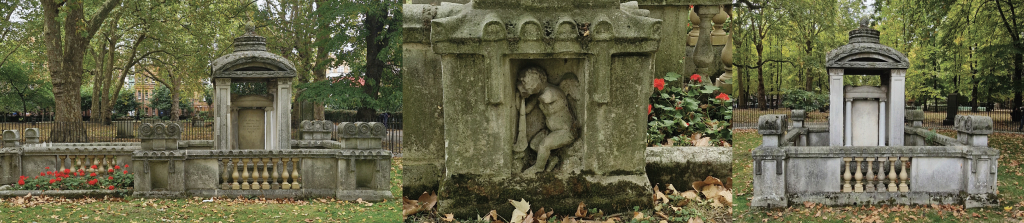
The Soane Tomb first drew my attention. Its canopy-like structure, flanked by cherubs on one side, suggested an intimate act of devotion expressed through architecture. Its later influence on London’s red telephone booth extended this personal gesture into collective memory. Perec’s idea that “the street, the neighbourhood, the city are accumulations of the lived, the observed, the remembered” (Peres, 1974, p. 91) becomes visible here: private love reshaping public form, grief turning into shared design.

The Burdett-Coutts Memorial Sundial revealed another dimension of memory. Guarded by lions and dogs and decorated with mosaic, it’s layers of pattern and inscription demanded time and attention. The more I circled the monument, the more I found – each encounter uncovering care and purpose.
Cardiff (1999) writes that her sound walks depend on listener’s physical movement to “activate the narrative”. Likewise, walking around the sundial transformed passive viewing into participation, memory unfolded through motion.
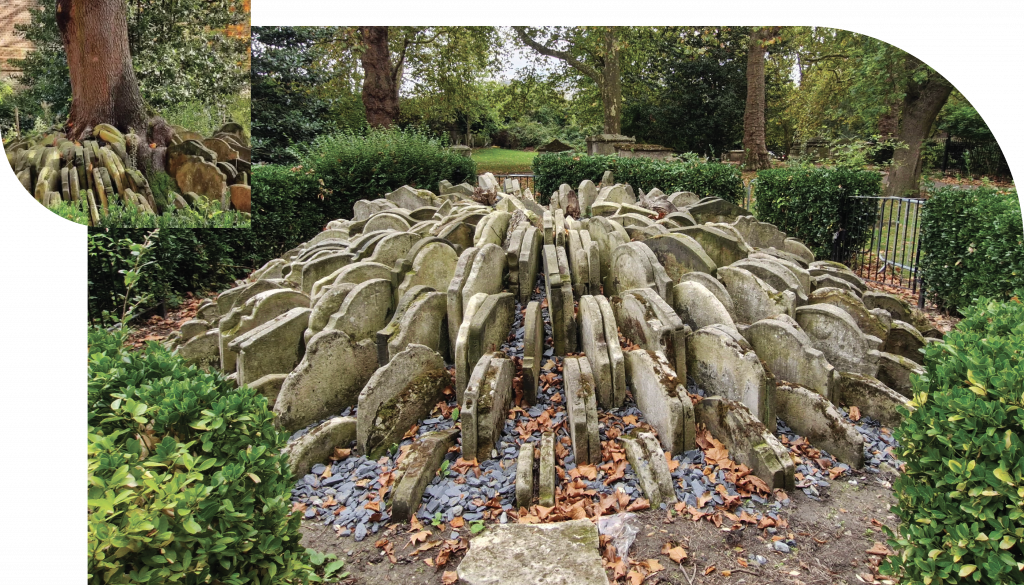
At the site of The Hardy Tree, absence itself carried meaning. The original tree, lost to disease in 2022, had once gathered gravestones relocated by a young Thomas Hardy. What began as an act of order became a natural sculpture – human planning overtaken by growth. Perec’s claim that “what we call ordinary is what we fail to observe” (Perec, 1974, p. 50) resonates here: the mound’s quiet persistence shows how memory continues through observation rather than monumentality.
Alongside these explorations and observations, I created a publication of my research and findings designed to guide visitors through the garden and prompt reflection, turning the act of walking into an exploration of memory and presence. I also conducted an online survey to collect the silent questions that might linger rather than answer:

What role does memory play in how we experience a place?
Do we live on through what we create or through how we are remembered?
Can love expressed through memorials endure decay?
These emerged from my time in the garden, especially the Hardy Tree, where memory felt active – non static – shaped by weather, growth and time.

Critically this process deepened my understanding of observation as an act of creation. Through Cardiff, I learnt that presence completes the work: through Perec, that attention transforms spaces.
St Pancras Garden became a dialogue between presence and absence, where memory is relational and continually rewritten.
For future studio practice, this encourages methods rooted in reflection and participation – creating experiences where spaces, like memories speak through those who choose to look.
References
Cardiff, J. (1999) The Missing Voice (Case Study B). London: Artangel.
Perec, G. (1974) Species of Spaces and Other Pieces. London: Penguin, 1997.
