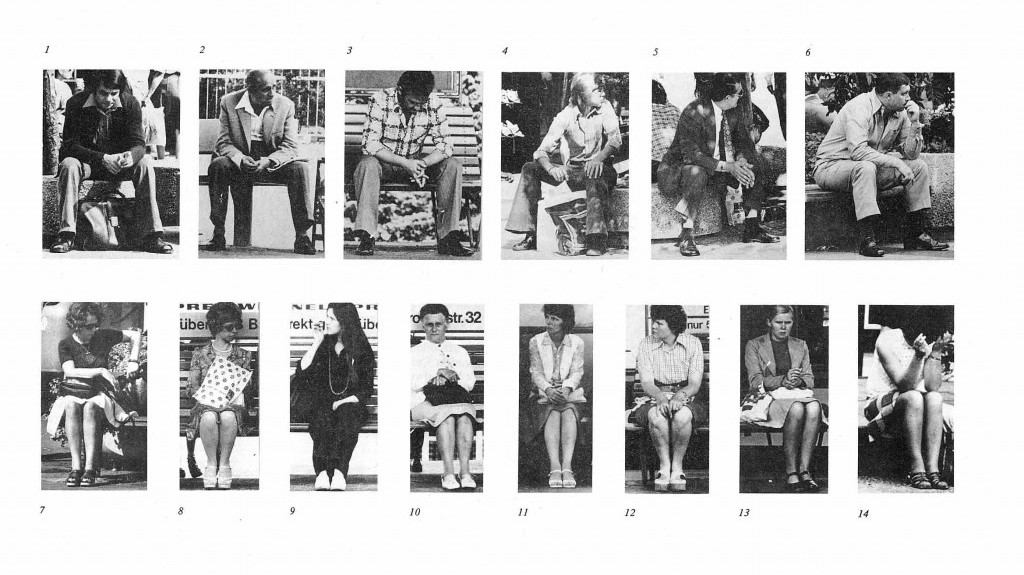
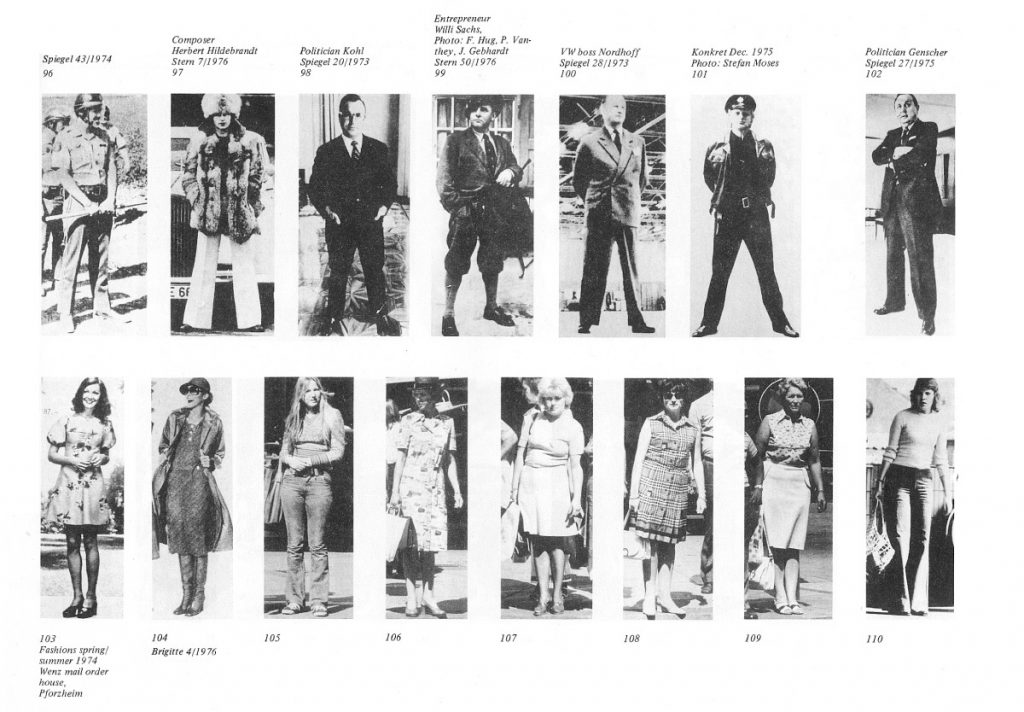
Marianne Wex’s Let’s Take Back Our Space: “Female” and “Male” Body Language as a Result of Patriarchal Structures; is a systematic yet radical approach to visual analysis. Wex’s process of collecting, classifying and comparing everyday gestures exposes how ideology is embedded in bodily posture. I apply the inventory method to mirror her process, translating her visual typologies into textural form. This approach can both reveal and reinforce systems of power.
Inventory of Marianne Wex’s Let’s Take Back Our Space (1979)
Reflection
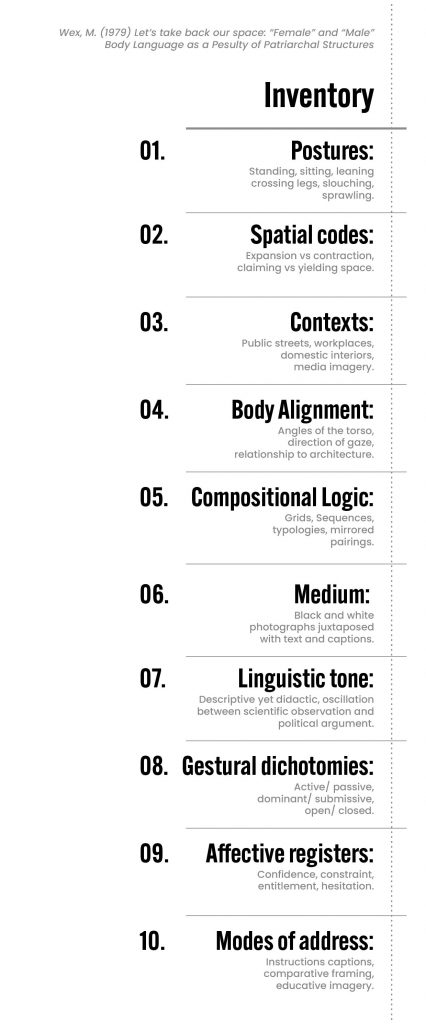
This inventory isolates the thematic structures underpinning Marianne Wex’s texts, the project is itself an archive of postures, a typology of how gender occupies space. By itemising it’s visual and conceptual components, this list mirrors her methods while making visible its underlying system, one built on repetition, contrast and classification.
Writing this inventory became an extension on Wex’s own method, where form itself becomes a mode of thinking. The process of listing draws attention to the precision of Wex’s visual argument. Each posture and space taken is not unique but impeccable as a specimen within a broader taxonomy. As she writes “The female posture is a learned response to male dominance, visible in every muscle” (Wex, 1979, p.34). By cataloging these gestures and breaking it down individually, I began to see how Wex exposes the quiet ways power shapes behaviour – not through rules, but through the small habits of how bodies move and hold space.
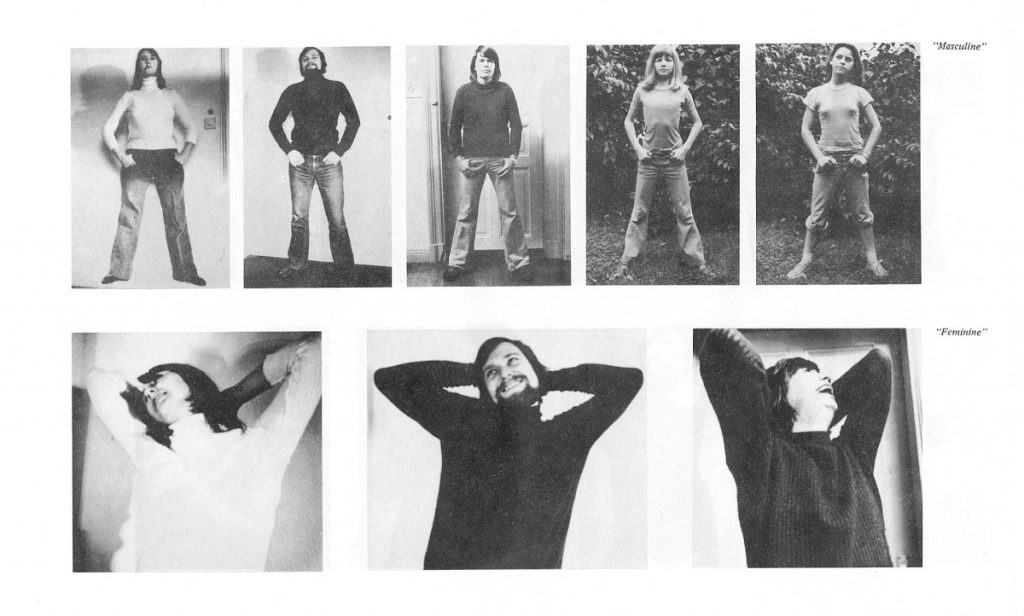
However, I notice the list also exposes a tension between order and experience. While Wex’s grids aim to revel a systemic pattern, their forms risk flattering individuality, turning living bodies into data points. This paradox is echoed in my inventory making Wex’s ideas clearer, but in doing so, it loses some of the depth and sensitivity of her images. What’s left unlisted are the subtleties of emotion, movement and resistance that exceed categorising.
Through making an inventory of Wex’s work the text is a map of control, not just how the bodies are positioned, but of how information is arranged. Just like Wex’s grids, my list both shapes how we see, and show us that our seeing is shaped. By analysing Wex’s own order system I’m reminded that whenever we try to organize or classify things, we’re also exercising power, and even systems created to challenge power can end up repeating some of its structures.
References
Wex, M. (1979) Let’s take back our space: “Female” and “Male” Body Language as a Pesulty of Patriarchal Structures. Hamburg: Frauenliteratur Verlag.